How AI is turning video into real-time intelligence

Video-as-a-sensor transforms cameras into AI-powered data sources, enabled by reliable, low-latency cellular and 5G connectivity.
No more pressing the crosswalk button and hoping for the best. The future of urban safety is smart enough to stop traffic for you. Las Vegas, a city known for its massive pedestrian traffic, is transforming video from a passive recording tool into an active sensor by installing 16 AI-equipped cameras along the bustling Fremont Street Experience. These devices don’t just film the streets. They actively detect the volume of pedestrians waiting to cross and communicate with traffic lights in real-time, extending walk signals automatically to accommodate large crowds of tourists.
This pilot program highlights the massive difference between a camera that only records and a camera that also analyzes what it sees. Video-as-a-Sensor ((VaaS) combines high-resolution cameras with AI-powered analysis to detect motion, recognize objects, and trigger automated responses in real time. This shift is happening right now as video sensors become a distinct and rapidly growing category within IoT, estimated to reach a market size of 115B by 2030.
Learn more about VaaS in this article that covers how these systems work, the connectivity infrastructure they require, and the industries putting them to use.
What are video IoT sensors?
Video IoT sensors are cameras that capture visual data and can automatically analyze it to detect motion, objects, and, in some implementations, faces or certain environmental changes. Unlike traditional surveillance cameras that simply record footage for someone to review later, video IoT sensors process information in real time and turn it into actionable insights.
Think of it this way. A traditional security camera is like a notebook that stores information. A video IoT sensor is more like an assistant that watches, understands, and immediately tells you when something important happens.
The term "video as a sensor" describes this shift. Cameras with multiple sensors can actively gather data and make sense of what it sees, just like a temperature sensor measures heat or a motion detector tracks movement. The difference? Video captures far more context than any single-purpose sensor ever could.
Artificial intelligence makes this possible
Sophisticated computer vision algorithms can run directly on the camera itself or be processed in the cloud and are essentially "trained" to be excellent digital observers. They learn to identify specific objects, like a car pulling into a restricted zone, and recognize patterns of behavior. This is crucial because it helps the system distinguish between routine activity, like a delivery truck driving past, and something that might actually be a potential concern. Another huge benefit is that the system is smart enough to flag and save only those short, vital moments that truly matter.
Benefits of using video as IoT sensors
Organizations are increasingly moving beyond simple alerts to seek comprehensive, contextual understanding of their environments. This shift explains why video sensors are often chosen over traditional single-purpose sensors: they capture vastly richer information, offer greater deployment flexibility, and consolidate multiple sensing functions. While a basic motion detector only confirms that something has moved, a video sensor immediately illuminates the complete picture of what moved, where it went, and what it did next.
- Automated visual analysis: AI scans video feeds continuously, looking for specific events or anomalies without requiring someone to watch a screen all day.
- Richer contextual data: Video provides the complete visual picture of an event, offering far more detail than temperature readings or motion alerts alone.
- Real-time actionable insights: Video sensors can trigger immediate alerts and automated responses the moment something happens, rather than after the fact.
The combination of automation, rich context, and speed allows organizations to streamline decision-making and dramatically accelerate response times. By offloading continuous monitoring to advanced AI, teams are freed to focus their expertise exactly where human intervention is most critical. But the value of video goes far beyond simple observation. It delivers the data for predictive analysis and operational optimization.
Technologies powering video IoT sensors
The transformation of raw video footage into actionable, useful information is a complex process made possible by the integration of several core technologies. Understanding the role of each component, from the initial capture device to the final processing platform, is essential for understanding how modern video sensors achieve intelligence and connectivity.
Cellular and 5G connectivity
Cellular networks provide the backbone for transmitting video data from locations where WiFi isn't available or reliable. Remote sites, mobile assets, and outdoor installations all benefit from cellular connectivity because it doesn't depend on local infrastructure.
5G plays an increasingly important role here. With higher bandwidth and latency dropping to 1-4 milliseconds compared to earlier cellular generations, 5G makes real-time, high-quality video streaming more practical and scalable than before. For organizations deploying video sensors across many locations, cellular often offers flexibility and geographic reach that are difficult or costly to achieve with wired connections.
Edge computing for local processing
Edge computing refers to processing data locally, on or near the device itself, rather than sending everything to a centralized cloud. For video sensors, this means analyzing footage directly on the camera.
Why does this matter? Video files are large. Transmitting all that data continuously would be expensive and slow. With edge processing, the camera identifies important events locally and sends only relevant clips or alerts to the cloud. This approach can reduce data volume by up to 90% (https://www.marketgrowthreports.com/market-reports/video-analytics-market-103370) and speeds up response times.
Artificial intelligence and computer vision
Computer vision is a field of AI that trains computers to interpret visual information. In video IoT sensors, computer vision algorithms automatically identify objects, people, behaviors, and anomalies within video feeds.
The AI turns raw footage into structured data. Instead of hours of video to review, you get specific, tagged events: "Person entered Zone A at 2:47 PM" or "Vehicle stopped in loading area for 15 minutes." This transformation is what makes video useful as a sensor rather than just a recording device.
Cloud platforms for video data storage
Cloud platforms provide the scalable infrastructure to store, manage, and analyze video data over time. They make footage and insights accessible from anywhere, which is essential for organizations managing multiple locations.
The cloud also enables long-term pattern analysis. By storing historical data, organizations can identify trends and anomalies that wouldn't be visible from a single day's footage. Over time, when combined with appropriate machine learning models and tuning, the system can become better at distinguishing what's normal from what isn't.
How video IoT sensors deliver real-time intelligence
Turning raw video into actionable intelligence is a well-orchestrated process where each step adds context, efficiency, and insight. From the moment a camera captures footage to the instant an alert is triggered, video IoT sensors work continuously to separate meaningful events from background noise.
Capture and intelligent edge processing
The journey begins at the camera. As video is captured, the device immediately performs on-device (edge) analysis to interpret what it sees. Instead of passively recording everything, the sensor actively looks for predefined conditions and behaviors, such as a person entering a restricted area, loitering, or movement outside normal hours. Routine activity is filtered out, while moments that matter are flagged for further action. This early decision-making dramatically reduces unnecessary data and speeds up response times.
Efficient transmission over cellular networks
When a relevant event is detected, only the most important information is sent over the cellular network. This may include a short video clip, a snapshot, or an alert enriched with metadata like time, location, and event type. Because the heavy lifting happens at the edge, bandwidth usage stays low and predictable, making cellular connectivity practical even for remote or bandwidth-constrained locations.
Advanced analytics and pattern recognition
Once the data reaches the cloud or a central server, more sophisticated AI models take over. These systems analyze events in a broader context, validating them against rules, identifying anomalies, and spotting trends over time. By correlating inputs from multiple cameras and sensors across sites, the platform can uncover patterns that wouldn’t be visible from a single device to transform isolated events into meaningful operational insight.
Automated alerts and intelligent system integration
The final step is action. When the system determines that an event requires attention, it automatically notifies the right people through dashboards, mobile alerts, or existing security tools. Just as importantly, it can trigger automated responses across connected systems. A detected intrusion might lock doors, activate lighting, adjust HVAC settings, or notify on-site personnel, closing the loop from detection to response in seconds.
Delivering real-time intelligence from video sensors depends not only on advanced edge and cloud analytics, but also on the connectivity that carries critical insights from the moment of detection to the moment of action.
New demands for your connectivity backbone
Because video IoT sensors don’t just capture footage, their connectivity requirements go beyond simple data transport. The network must support fast, reliable delivery of high-value insights, not raw video streams.
Bandwidth optimized for event-driven video
Unlike traditional IoT sensors that transmit small packets of text data, video sensors work with richer data types such as images, short clips, and metadata. Continuous high-resolution streaming would require substantial bandwidth, but modern video IoT systems rely on edge processing to transmit only what matters. By sending event-based clips or alerts instead of nonstop video, cellular networks can support scalable deployments without excessive data usage.
Low latency to preserve real-time intelligence
In a video IoT pipeline, latency directly impacts outcomes. Delays between event detection, data transmission, and system response can undermine use cases like security, safety, and operational automation. Low-latency connectivity ensures that alerts, analytics, and automated actions occur while events are still unfolding, keeping “real-time” intelligence truly actionable.
Reliable connectivity with multi-carrier redundancy
Since video IoT sensors often operate in unattended or remote locations, connectivity failures can leave critical events unseen. Multi-carrier redundancy allows devices to automatically switch networks if signal quality degrades or a carrier experiences an outage. This resilience is essential for maintaining continuous visibility and trust in mission-critical deployments.
Global coverage for distributed sensor networks
Video IoT deployments frequently span cities, countries, or continents. Consistent global cellular coverage allows organizations to use the same sensor platform, analytics pipeline, and management tools everywhere. This simplifies scaling, reduces operational overhead, and ensures that real-time intelligence is delivered consistently—regardless of location.

Video as a sensor delivers value across industries
As we covered earlier, video is increasingly used as an IoT sensor because it captures context, not just signals. Unlike traditional sensors that report a single measurement, video systems observe movement, behavior, and interactions across space and time. When combined with edge processing and analytics, video becomes a high-fidelity data source that can drive automated decisions, optimize operations, and reduce risk.
Across industries, organizations are using video sensors to replace manual observation, respond faster to real-world conditions, and achieve measurable improvements in efficiency, safety, and performance. Let’s take a look at a few examples to see where this technology is delivering value.
Smart cities and traffic management
In traffic environments, video sensors function as adaptive, real-time inputs rather than fixed infrastructure. By continuously measuring vehicle counts, speeds, lane usage, and incident patterns, they allow traffic systems to respond dynamically to actual road conditions. This enables faster accident detection, congestion-aware signal timing, and priority routing for emergency vehicles. The result is reduced idle time, improved throughput at intersections, and more predictable travel times without adding physical sensors to the roadway.
Healthcare and patient monitoring
In healthcare settings, video sensors provide situational awareness that wearable or bedside sensors often miss. By observing patient posture, movement patterns, and activity levels, they can identify fall risks, detect unsafe behavior, and flag deviations from normal routines. This allows care teams to intervene earlier, reduce preventable injuries, and allocate staff attention more effectively. In elder care and long-term facilities, video sensing improves safety while helping teams scale care without constant physical supervision.
Retail security and customer analytics
In retail environments, video sensors turn physical spaces into measurable, data-driven systems. Beyond detecting theft or suspicious behavior, they quantify customer movement, dwell time, queue formation, and traffic flow throughout the store. These insights help retailers reduce shrink, optimize staffing, and refine store layouts based on how customers actually behave, not assumptions. A single camera infrastructure supports both security operations and revenue optimization.
Logistics and fleet tracking
For logistics and transportation, video sensors act as both operational verification and safety enforcement tools. On vehicles, they provide visual confirmation of deliveries, cargo condition, and driving behavior, helping reduce disputes, insurance claims, and accidents. In warehouses and yards, video sensing tracks the flow of goods, identifies congestion points, and highlights unsafe practices. This visibility improves throughput, reduces downtime, and strengthens accountability across distributed operations.
Manufacturing and quality control
In manufacturing, video sensors enable continuous inspection at production speed. They detect defects, assembly errors, and process deviations that would be difficult or impossible to catch manually. At the same time, they monitor work areas for safety risks such as improper machine use or restricted-zone entry. By combining quality assurance and safety monitoring in a single system, manufacturers reduce scrap, prevent injuries, and maintain consistent output without slowing production.
Here's what to consider when deploying video IoT sensors
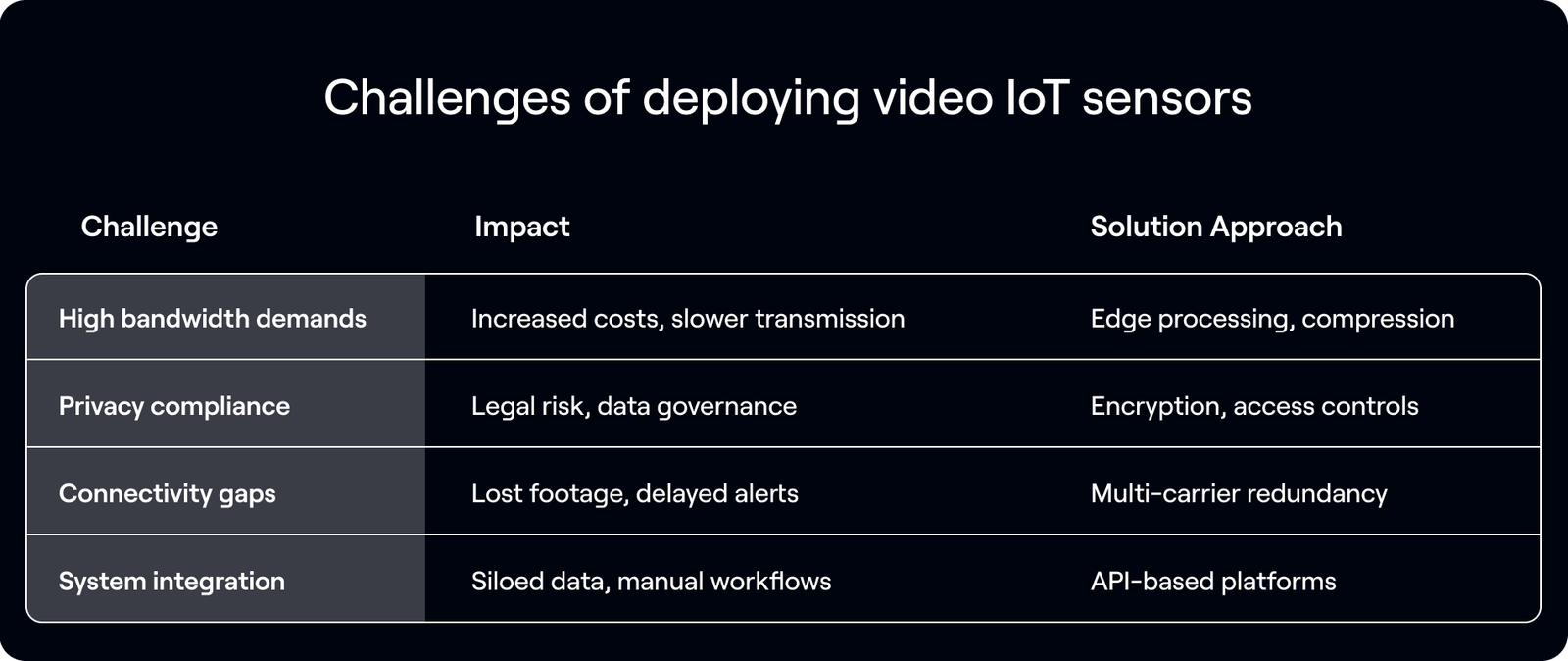
While video IoT sensors unlock powerful new capabilities, deploying them at scale introduces challenges that go beyond traditional IoT rollouts. Video is a high-value data source, but it is also complex, bandwidth-intensive, and closely tied to privacy concerns. Understanding these constraints early helps organizations design systems that are both effective and sustainable.
Managing data volumes and transmission costs
Video generates orders of magnitude more data than most IoT signals. Left unchecked, continuous streaming can quickly overwhelm cellular links and drive up operating costs. Organizations must make deliberate tradeoffs around resolution, frame rate, and retention policies, and decide where processing should occur. Edge analytics play a critical role here by filtering routine activity and transmitting only events, clips, or metadata. That enables networks to carry insights rather than raw footage.
Ensuring data privacy and regulatory compliance
Video sensors often capture people, behavior, and environments, making privacy a central concern rather than an afterthought. Regulations such as GDPR, and HIPAA in healthcare settings, impose strict requirements on how video data is collected, stored, and accessed when it can be tied to identifiable individuals or protected health information. Beyond technical safeguards like encryption and role-based access control, organizations must clearly define what they record, how long data is retained, and who is authorized to view it. Poorly scoped deployments can create compliance risk even when the technology itself is sound.
Maintaining consistent connectivity at scale
Deploying a handful of video sensors is relatively straightforward; managing hundreds or thousands across diverse locations is not. Video sensors are often placed in remote, mobile, or unattended environments where network conditions vary widely. Ensuring reliable, low-latency connectivity at scale requires more than individual SIM cards. It demands centralized management, visibility into network performance, and the ability to adapt as conditions change. Without this foundation, even the best analytics fail when data can’t be delivered consistently.
Integrating video sensors with existing IoT systems
Video sensors rarely operate in isolation. Their value increases when insights can trigger actions across broader IoT workflows, like alarms, access control, operational systems, or analytics platforms. Integrating video into an existing IoT ecosystem can be challenging due to incompatible data formats, legacy protocols, or siloed systems. API-driven architectures help bridge these gaps, but successful integration still requires upfront planning to ensure video-derived intelligence can flow smoothly into downstream systems.
Video sensors are anticipating the future of IoT
The next generation of video sensors is moving beyond simply observing events to anticipating them. With more sophisticated AI and machine learning, video systems are beginning to perform predictive analysis, spotting patterns that hint at what might happen next. Imagine a factory camera that flags a potential equipment failure before it occurs, or a retail sensor that predicts overcrowding at checkout lanes and alerts staff in advance. These capabilities transform video from a passive record into a proactive decision-making tool. These are just a few examples of what's next across industries
Manufacturing: Improving quality and uptime
On production lines, video sensors integrated with AI can detect small anomalies that signal a looming defect or machine malfunction, enabling preemptive maintenance. Video data could also orchestrate robotic systems to adjust workflows automatically, preventing downtime and maintaining consistent product quality.
As these examples show, the future of video sensors is not just about recording what happens. It’s about anticipating what will happen, integrating across IoT systems, and enabling proactive, automated responses. The Video-as-a-sensor ecosystem will turn video from a passive observation tool into a central intelligence hub for smarter, faster, and safer operations across industries.
Smart cities: Predicting traffic jams
Municipalities are beginning to deploy multi-camera networks that do more than detect accidents. They can predict congestion hotspots based on vehicle and pedestrian movement patterns. In some trials, cameras in city intersections automatically recommend signal timing adjustments to prevent jams before they form, while simultaneously alerting first responders to likely collision risk zones.
Healthcare: Anticipating dangers
Hospitals and elder care facilities are exploring video sensors that anticipate patient falls or detect early signs of medical distress, such as unusual movement patterns or extended inactivity. Predictive video analytics could automatically notify staff and adjust care workflows, reducing response times from minutes to seconds.
Retail: Enhancing the customer experience
Retailers are combining video sensors with AI to forecast crowding and optimize staffing in real time. For instance, cameras could detect an emerging queue and automatically adjust checkout counters or deploy staff before customer frustration builds, simultaneously reducing shrink and improving the shopping experience.
Logistics and fleet operations: Alerting drivers
Connected vehicle cameras are evolving to predict driver fatigue or unsafe maneuvers before an incident occurs, alerting the driver or dispatchers proactively. In warehouses, video sensors may predict inventory bottlenecks or misrouting, allowing automated conveyor adjustments to maintain throughput.
It starts with reliable connectivity
Even the smartest video sensors are only as effective as the network that connects them. Building reliable video IoT infrastructure starts with choosing a connectivity solution designed for high availability, global reach, and scalability. Cellular networks are often the backbone of these deployments, enabling remote or mobile sensors to operate continuously, without the constraints of local Wi-Fi or wired connections.
The right connectivity partner doesn’t just provide coverage. They should simplify deployment, manage multi-carrier redundancy, and give you tools to scale SIM fleets across regions. This ensures mission-critical video applications, from real-time traffic monitoring to industrial safety systems, remain online and responsive at all times.
Without robust connectivity, advanced edge processing, AI analytics, and predictive insights can’t reach their full potential. With a scalable, global cellular solution, your video IoT network becomes a reliable, intelligent system, ready to capture, analyze, and act on real-world events.
Frequently asked questions about video IoT sensors
Can a camera be an IoT device?
Yes. When a camera connects to a network and transmits data for remote access or automated analysis, it functions as an IoT device. Smart cameras with built-in processing and cellular connectivity are purpose-built IoT sensors designed for connected applications.
How do video sensors work differently than traditional CCTV?
Traditional CCTV has historically focused on recording footage for later review by humans, though many modern systems now include basic analytics and alerts. Video IoT sensors are typically designed from the outset to analyze footage in real time using AI and to integrate with broader IoT systems to trigger automated alerts or actions.
What bandwidth is required for video IoT sensors?
Video sensors require significantly more bandwidth than traditional IoT sensors due to large file sizes. However, edge processing and compression techniques can reduce transmission demands substantially. The exact requirements depend on video quality, frame rate, and how much analysis happens on the device versus in the cloud.
What is the Internet of Video Things?
Some observers use the term Internet of Video Things (IoVT) to describe an emerging ecosystem of connected video devices, platforms, and analytics tools designed to manage and extract intelligence from video sensor data. This concept highlights that video can have unique requirements within IoT and may benefit from specialized infrastructure and practices.