Cellular connectivity for video IoT sensors: A complete guide

This complete guide to cellular connectivity for video IoT sensors covers connectivity options, edge AI, deployment tips, and real-world use cases.
What do a package that arrives on time, the traffic light that adjusts before congestion builds, and the farm that catches crop disease early all have one thing in common? A small camera that captures video and turns it into actionable data!
Increasingly, those cameras aren’t plugged into a wall or tied to a Wi-Fi router. They’re connected through cellular networks, sending insights from wherever they happen to be, such as a moving vehicle, in the middle of a field, or a construction site. This guide explores how cellular connectivity is transforming cameras into powerful video IoT sensors, and why that shift is changing what’s possible in security, infrastructure, industry, and more.
What are video IoT sensors
Cellular IoT connectivity enables video cameras to function as remote, intelligent sensors by transmitting live feeds, alerts, and metadata directly to the cloud via 4G LTE or 5G. This approach bypasses the need for local wired networking infrastructure and avoids reliance on local Wi-Fi networks, making it ideal for remote, mobile, or hard-to-reach locations where traditional wired or wireless connections aren't practical.
What exactly makes a camera an "IoT sensor"? It comes down to independence. Video IoT sensors connect to the internet on their own and share data without someone physically retrieving footage or plugging in cables. They range from basic security cameras to sophisticated imaging systems with built-in AI that can analyze footage right on the device.
Many video IoT sensors process footage locally and only transmit the clips or alerts that actually matter. A camera watching a warehouse entrance doesn't need to stream eight hours of an empty doorway. Instead, it sends a clip when someone walks through. This intelligent edge processing keeps bandwidth costs down while still delivering the insights you care about.
Why video IoT sensors need cellular connectivity
At first glance, Wi-Fi or wired Ethernet might seem like the obvious way to connect video cameras as that's how traditional surveillance systems have operated for years. However, both wired and Wi-Fi networks introduce operational, financial, and scalability challenges that cellular connectivity is uniquely positioned to solve.
Video IoT sensors are designed to operate independently. They aren’t meant to rely on local IT teams, fixed infrastructure, or complex network configurations. Cellular connectivity reinforces that independence by allowing cameras to connect directly to the cloud, no matter where they are deployed. Let’s take a closer look at why cellular connectivity offers an advantage over other connectivity solutions.
Wired and Wi-Fi connections for video have limitations
Wired infrastructure can work well in permanent indoor environments, but it quickly becomes restrictive outside of those conditions. Running Ethernet or fiber to every camera location requires trenching, conduit installation, switches, routers, and ongoing maintenance. In dynamic environments like construction sites, where layouts change weekly, cabling becomes both expensive and impractical. The same is true for agricultural fields that stretch across hundreds of acres, oil and gas operations in remote terrain, or temporary event spaces that exist for only a few days.
Wi-Fi introduces a different set of complications. While convenient indoors, it struggles in outdoor or industrial settings. Signal strength drops over distance, and interference from other devices can disrupt connectivity at critical moments. Metal structures, heavy machinery, concrete walls, and even weather conditions can degrade signal reliability. Network congestion during peak usage can also affect video quality.
Importantly, Wi-Fi still depends on local internet backhaul. If the primary broadband connection fails, every connected camera loses its link to the cloud. For remote monitoring applications, that kind of dependency can be a serious liability.
Cellular offers advantages for remote and mobile video capture
Cellular connectivity removes the need for local networking infrastructure altogether. Cameras can connect directly to the cloud without relying on on-site routers or broadband lines. This dramatically expands where and how video IoT sensors can be deployed.
Consider a camera mounted on a shipping container traveling along major transportation routes. Or a drone surveying farmland within network coverage. Or a temporary security installation at a music festival. In each case, cellular connectivity allows the device to transmit video and alerts in real time without requiring any fixed infrastructure.
This independence fundamentally changes what’s possible. Deployment timelines shrink from days to minutes. Cameras can be installed wherever there is coverage, power, and a secure mounting point. There is no need to request access to internal corporate networks, configure firewalls, or coordinate with local IT teams. For enterprises managing dozens or hundreds of distributed locations, that simplicity is transformative.
Bandwidth and latency matter for video
Video is inherently data-intensive. Bandwidth determines how much video information can flow through a connection at once, while latency measures how quickly that information reaches its destination. For real-time monitoring and alerting, both are critical.
A delayed or choppy feed can undermine the entire purpose of remote video monitoring. In security applications, seconds matter. In industrial settings, real-time visibility can directly impact operational decisions and safety outcomes.
Modern 4G LTE networks provide sufficient bandwidth for high-definition, event-based video transmission. Emerging 5G networks push this further, enabling higher throughput and lower latency, which supports higher-resolution video streams and near real-time analytics. However, the intelligence built into video IoT sensors reduces the burden on networks in the first place.
Many devices process footage locally using edge AI. Instead of streaming continuously, they transmit only event-triggered clips or relevant metadata. Advanced compression standards such as H.265 help further reduce data usage. This combination of edge processing and cellular connectivity balances performance with cost efficiency.
Key benefits of cellular video connectivity
Cellular technology is an excellent solution for video applications, offering strong performance even in challenging environments. Beyond working in remote locations, cellular provides several key advantages that make it particularly well-suited for video.
Reliable connectivity across any location
Cellular carriers have invested billions in infrastructure designed for broad geographic coverage. Even in many rural areas where wired broadband doesn't exist, cellular signals may still be available and usable, though coverage and performance can vary by region.
This reliability can extend to challenging environments like underground parking garages and dense city blocks when the sites are equipped with appropriate cellular repeaters or in‑building coverage systems, as well as remote industrial facilities located within carrier coverage.
Built-in security for video data transmission
Modern LTE and 5G cellular networks encrypt traffic over the air as a standard feature, adding a baseline layer of protection. For sensitive video, however, you should still use application-level security such as TLS or VPNs to ensure end‑to‑end encryption.
This matters especially for sensitive applications. Healthcare monitoring, financial institution surveillance, and other high-stakes use cases benefit from encryption that's already baked in, but should layer additional security measures on top.
Automatic failover and network resilience
Multi-carrier SIM technology can be configured to switch to alternative networks when connectivity issues are detected. These transitions are largely automated from an operations standpoint, though they may cause brief interruptions to active sessions and depend on device and carrier settings.
For mission-critical video monitoring, this redundancy significantly reduces the coverage gaps that can occur when relying on a single carrier.
Simplified deployment without physical infrastructure
Once power and mounting are in place, bringing a cellular-connected camera online can often be done in minutes, instead of waiting days for new wired network infrastructure. There's no waiting for internet service providers, no digging trenches for cables, no configuring routers and switches.
This speed translates directly into cost savings. You're up and running faster, which means you start getting value from your deployment sooner.
Scalability from single devices to enterprise fleets
Starting with one camera? You can add hundreds more using the same connectivity approach. Modern management platforms let you oversee growing deployments from a single dashboard, whether you're expanding within one building or across multiple countries. Over-The-Air (OTA) updates help manage firmware and application logic, extending the device's useful life and enabling remote feature upgrades.
Best cellular networks for video IoT sensors
Not all cellular networks deliver the same performance. The right choice depends on your video quality requirements and budget. Actual performance will vary based on location, network congestion, and other factors.
LTE Cat 1 and Cat 4 for standard definition video
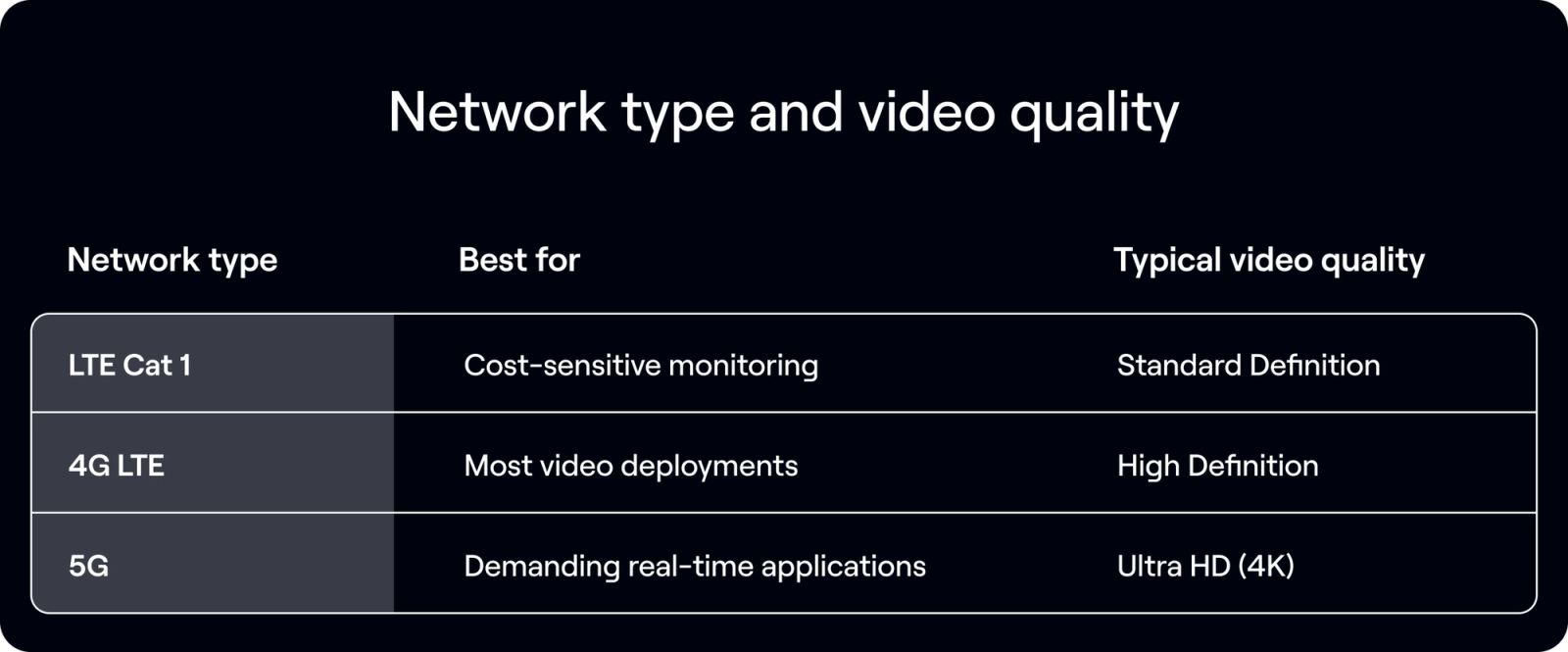
LTE Cat 1 and Cat 4 are often overlooked in video discussions, but they remain highly practical for many monitoring applications. LTE Cat 1 provides modest data speeds that are sufficient for standard definition (SD) video, periodic image snapshots, and event-triggered clips. Because Cat 1 modules are cost-effective and power-efficient, they are particularly attractive for deployments where video is used primarily for verification rather than continuous surveillance. If your goal is to confirm whether a gate is open, check if a delivery has arrived, or verify that equipment is operating, SD video is often more than adequate.
Cat 4 increases throughput significantly while remaining widely available and affordable. It offers more headroom for smoother streaming and improved reliability, especially in environments where signal quality fluctuates. For many remote monitoring applications, Cat 4 strikes a balance between performance and cost without stepping into higher-tier pricing structures.
4G LTE for high definition video streaming
For most video IoT deployments today, 4G LTE represents the practical sweet spot. It delivers enough bandwidth for consistent high-definition (HD) video while offering broad, mature network coverage across urban, suburban, and many rural areas.
The ecosystem around 4G LTE is well established. Hardware modules are widely available, data plans are competitively priced, and coverage maps are predictable. This maturity reduces deployment risk and simplifies procurement decisions. For businesses scaling across multiple regions, that reliability matters just as much as raw speed.
HD video streaming—whether continuous or event-driven—fits comfortably within typical 4G LTE capabilities. Combined with modern compression standards and edge processing that filters unnecessary footage, 4G LTE can support most security, industrial monitoring, and smart infrastructure applications without issue.
5G for ultra HD video and real-time applications
5G introduces higher bandwidth and lower latency, making it well suited for more demanding video applications. Ultra HD (4K) streaming, multi-camera aggregation, and near real-time AI analytics all benefit from the expanded capacity 5G provides.
Latency improvements are especially meaningful for interactive or time-sensitive workloads. Applications such as remote equipment control, drone operations, traffic coordination systems, or real-time hazard detection depend on rapid data transmission and minimal delay. In these scenarios, even small improvements in latency can enhance responsiveness and decision-making accuracy.
Additionally, 5G’s higher throughput makes it easier to scale dense deployments in urban environments where many devices operate simultaneously. This can support smart city initiatives, advanced retail analytics, or large-scale event monitoring.
Cellular video IoT use cases and applications
The flexibility of cellular connectivity has enabled video IoT adoption across a wide range of industries. Beyond surveillance, video is increasingly acting as a sensor to detect movement, interpret behavior, and provide real-time insights in environments where traditional wired networks don’t reach.
Because of this shift toward Video-as-a-Sensor many markets tied to connected video systems are projected to grow significantly over the coming decade.

Security and monitoring systems
Security remains the most established use case for video IoT sensors. Remote facilities, construction sites, and temporary locations all benefit from cellular-connected cameras that don’t rely on local IT infrastructure. These systems deliver real-time monitoring and instant alerts when motion or anomalies are detected, reducing the need for physical patrols or manual footage review.
The broader video surveillance market, which represents the backbone of video IoT deployments, is projected to reach approximately $147.66 billion by 2030, driven by increased demand for intelligent analytics, cloud technology, and AI-enhanced detection.
Protecting nature
A wildlife reserve deploys cellular cameras at remote watering holes. Instead of recording constantly, the cameras analyze video locally and only send alerts when poachers or unusual animal movement is detected, triggering rapid response from rangers. Here the cameras act as smart intrusion and activity sensors, not just recording devices.
Construction monitoring
Video as a Service (VSaaS) enables construction managers to remotely monitor job sites in real-time for enhanced security, reducing theft and vandalism through AI-powered surveillance. Job site safety can be improved by using computer vision to track compliance with personal protective equipment (PPE) requirements and detect hazardous worker behavior.
Additionally, time-lapse video services from companies like Timescapes are used to visually show progress for stakeholders, aiding in productivity and even dispute resolution. Insights from AI video analytics have the potential to increase productivity in the construction industry by up to 50%.
Improving safety
A construction site installs high-resolution, durable cameras and an AI-powered platform to capture and analyze job site activity in real-time. Given that the construction industry accounts for over 46% of slips, trips, and falls, the site supervisors are constantly monitoring potentially life threatening safety incidents. Video monitoring can detect locations on the job site with high safety incidents, enabling supervisors to quickly take action to improve conditions and minimize risk.
Smart city traffic and infrastructure monitoring
In urban environments, video IoT sensors support traffic management, parking optimization, pedestrian flow tracking, and public safety monitoring. These applications are part of the larger smart city market, projected to reach approximately $1.4 trillion by 2030. Within that, intelligent video analytics serves as a key sensor layer, converting raw footage into data used to optimize municipal services.
Reducing congestion
A city equips intersections with cellular video IoT sensors that count vehicles and detect congestion in real time. When an unusual backlog builds at rush hour, the system reroutes traffic signals to optimize flow. The video sensors essentially become dynamic traffic flow detectors feeding live control systems.
Agricultural and environmental video monitoring
Agriculture is rapidly embracing connected devices to drive productivity and sustainability. While exact figures specific to video IoT in agriculture are varied, the broader Agriculture IoT market is forecast to reach about $60.12 billion by 2032, driven by precision farming, real-time monitoring, and automation.
Additionally, market analysts estimate crop monitoring solutions alone could approach $10.7 billion by 2032 as farms adopt video, satellite, and sensor technologies to increase yield and reduce waste. (GlobeNewswire ())
Improving crop yield
A large farm deploys cellular video sensors across its fields to monitor crop health. AI algorithms analyze color, texture, and movement patterns in video feeds to detect early signs of disease or water stress. Alerts are sent only when actionable conditions are detected, turning video into a crop condition sensor.
Drones and mobile inspection platforms
Video IoT sensors aren’t limited to fixed installations. Drones equipped with video sensors are increasingly used for infrastructure inspection, emergency response assessments, and 3D mapping. The drone inspection and monitoring market is forecast to grow from $15.2 billion in 2025 to $61.5 billion by 2035, reflecting strong adoption across energy, utilities, and infrastructure sectors.
Helping in emergencies
A utility company deploys a drone equipped with cellular video sensors to inspect power lines after a storm. The drone streams high-resolution footage back to analysts, who run AI models to detect damage or fallen lines. In this role, video acts as a mobile infrastructure condition sensor, identifying defects that require maintenance.
Industrial remote diagnostics and quality control
Manufacturing and industrial facilities are embedding video sensors throughout production lines for quality control, equipment monitoring, and safety compliance. As part of the broader video as a sensor market, which is forecast to grow from roughly $71.5 billion in 2024 to more than $114 billion by 2030, visual analytics is transforming industrial processes by providing near-real-time intelligence.
Improving quality
A factory deploys cellular video IoT sensors on its assembly line. These sensors analyze products for manufacturing defects in real time, automatically flagging and removing defective units from production. In this application, the video sensors function as automated quality control detectors, improving throughput and reducing waste.
How to deploy and manage cellular connectivity for video IoT sensors
Maintaining consistent performance in your video IoT deployment requires proactive strategies. A few key practices can help ensure reliability and smooth operation over time.
Optimizing connectivity for uptime
Choosing multi-carrier SIMs is a crucial step, as they can select among multiple available networks based on configured preferences and availability. This ability often significantly improves uptime compared to single-carrier approaches. Intelligent SIM technology can also detect connectivity issues and switch carriers without user intervention. For deployments spanning multiple regions or countries, global coverage becomes essential.
Achieving operational visibility
As deployments grow, operational efficiency becomes increasingly important. Managing ten cameras manually is tedious but doable. Managing a thousand requires better tools. Visibility into device status and data consumption patterns helps you identify issues before they affect operations.
Dashboards provide a single interface showing all device statuses, locations, and connectivity health saves enormous time compared to managing devices individually. You can spot problems at a glance rather than checking each device one by one.and automated alerts keep you informed without requiring constant manual checking.
APIs enable programmatic control over devices and integration of SIM data with existing business systems. Automation, like Over the Air (OTA) updates, reduces manual work and eliminates human error from repetitive tasks.
Future-proofing your deployment
Finally, even if your current deployments are regional, selecting connectivity solutions that scale internationally prevents painful migrations later. Your business may expand faster than you expect, and switching providers mid-deployment creates unnecessary complexity, cost, and risk.
Switching connectivity providers often requires hardware modifications, mass SIM replacements across thousands of devices, firmware updates, re-testing for compliance in new regions, and complex renegotiations of data plans and service level agreements (SLAs).
By proactively choosing a connectivity partner and a SIM technology that can seamlessly activate services across multiple countries and carriers from day one, you build a resilient, future-proof foundation that can absorb rapid international growth without requiring a complete overhaul of your IoT infrastructure.
FAQs about cellular connectivity for video IoT sensors
How much data does a cellular-connected video camera typically consume?
Data consumption varies based on resolution, frame rate, compression settings, and whether streaming is continuous or event-triggered. Most deployments plan for several gigabytes per device monthly, though high-resolution continuous streaming can require considerably more.
What is the difference between LTE-M and LTE Cat 1 for video IoT applications?
LTE-M is designed for low-bandwidth IoT sensors like temperature monitors and asset trackers. It is generally not suitable for continuous or high-quality video transmission, and only very low-resolution, low-frame-rate video would be feasible. LTE Cat 1 provides enough bandwidth for standard definition video streaming while remaining cost-effective.
Can cellular video IoT sensors operate in areas with weak signal coverage?
Yes. With external antennas and multi-carrier SIMs, devices can maintain connectivity in challenging signal environments. The ability to connect to whichever carrier has the strongest local signal improves reliability substantially.
How do you prevent buffering and latency issues with cellular video streaming?
Proper network selection, adaptive bitrate streaming, and edge compression help maintain smooth playback. Adaptive streaming automatically adjusts video quality based on available bandwidth, reducing buffering and helping maintain smoother playback when conditions fluctuate.
What happens to recorded video if cellular connectivity drops temporarily?
Many video IoT devices include local storage that can buffer footage during outages. When connectivity resumes, the device automatically uploads the stored recordings, ensuring no footage is lost during the gap. If continuous recording is critical, ensure your chosen devices have sufficient local storage for your outage scenarios.
Is cellular connectivity more expensive than Wi-Fi for video IoT deployments?
Although cellular involves ongoing data costs that Wi‑Fi does not, it can eliminate substantial infrastructure expenses and enable deployments in locations where Wi‑Fi is impractical. The total cost of ownership may favor cellular once installation, maintenance, and volume discounts are factored in, so a case-by-case TCO analysis is recommended.