Why Hologram leads in cellular connectivity for video IoT devices

Hologram is the leading choice for cellular connectivity in video IoT devices, offering multi-carrier redundancy, automatic carrier switching, and a 99.95% platform uptime SLA.
A security camera that loses connection isn't just inconvenient. It's a gap in your coverage, a missing piece of evidence, a blind spot that defeats the entire purpose of monitoring.
Video IoT devices typically demand more from connectivity than many other IoT applications, especially in terms of bandwidth and uptime. They stream data constantly, often from remote locations, and they can't afford downtime. This blog covers why cellular connectivity solves these challenges and how Hologram's platform delivers the reliability that video applications require.
What makes video IoT connectivity challenging?
Video IoT devices require reliable, high-bandwidth connectivity and minimal downtime. For globally deployed fleets, features like automatic multi-carrier switching across hundreds of networks help maintain continuous uptime. Unlike a temperature sensor that sends a tiny data packet every few minutes, a security camera streams data constantly. When that connection drops, you lose footage. And in security, lost footage can mean real problems.
The tricky part? Video devices often operate in places where traditional internet access doesn't exist. Think construction sites, parking lots, agricultural fields, or delivery trucks moving across the country. Wi-Fi isn't an option, and running cables is impractical or impossible.
Here's what makes video IoT connectivity particularly demanding:
- Bandwidth requirements: Video streams consume far more data than other IoT applications, requiring consistent throughput.
- Remote locations: Many video devices operate where Wi-Fi and wired infrastructure simply don't reach.
- Zero tolerance for downtime: A dropped connection means missing footage, which defeats the purpose of monitoring.
- Scale challenges: Managing connectivity across hundreds of devices in different locations gets complicated fast.
Here’s why cellular IoT is ideal for video applications
Cellular IoT connects devices to the internet through cellular networks instead of Wi-Fi or ethernet. For video applications, this approach solves the core connectivity challenges that make other options unreliable or impractical.
High bandwidth for video streaming
LTE and 5G networks deliver the throughput that video devices demand. A single HD security camera typically uses 1-2 Mbps of bandwidth consuming several gigabytes per month), and 4K cameras use even more. Cellular networks are engineered to manage many simultaneous users and can often handle this volume more predictably than small, shared Wi-Fi networks, where local congestion is common.
Low latency for real-time monitoring
Latency refers to the delay between when something happens and when you see it on screen. Modern LTE and 5G networks can often deliver latency of 30 to 50 milliseconds, which is generally suitable for real-time monitoring. If you're watching a live security feed or remotely operating equipment, that responsiveness matters.
Wide coverage for remote deployments
Cellular networks reach many places where wired or on-site Wi-Fi options aren't available. A camera monitoring equipment at a remote job site connects through the same infrastructure that serves smartphones in that area. You don't have to install networking equipment or negotiate with local internet providers.
Built-in security for video data
Cellular networks encrypt the radio link and authenticate each device by default, adding a strong security layer during transmission over the air. For sensitive video footage, you should still use end-to-end protections such as TLS or VPNs on top of cellular's built-in security.

Industries using cellular IoT for video
Video IoT applications appear across nearly every industry. Some use cases demonstrate particularly strong alignment with cellular connectivity.
Retail video analytics
In-store cameras analyze foot traffic patterns, customer behavior, and loss prevention. Dedicated cellular connectivity avoids competing with guest or POS systems for bandwidth and can simplify network segmentation policies. The subset of video analytics that processes visual data from cameras for behavior and movement insights is forecast to grow from ~$12.7 billion in 2024 to ~$37.8 billion by 2030.
Security and surveillance
Remote cameras monitor construction sites, vacant properties, and public spaces where wired connections don’t exist. Cellular connectivity enables deployment anywhere with network coverage, dramatically expanding where security operations can reach. Live video analytics enables real-time alerts and AI-driven detection and is forecast to grow from ~$1.35 billion in 2024 to nearly $3.85 billion by 2032 .
Fleet management and dash cams
Vehicle-mounted cameras document driver behavior, capture incident footage, and support insurance claims. Because vehicles travel widely, cellular is usually the most practical connectivity option, keeping cameras online across geographies. Adoption of AI-enabled cameras and cloud-based analytics is accelerating, with ~60% of fleets now reported using video analytics for safety and compliance.
Agricultural and livestock monitoring
Connected cameras reduce labor costs and improve operational efficiency, especially in remote agricultural settings. Cameras in fields and barns monitor crops, equipment, and animal health in areas without traditional internet infrastructure. Cellular connectivity brings visibility to operations that previously required physical checks. Given all of those benefits, it’s not surprising that the global smart agriculture market, including connected sensing and analytics, is expected to grow from ~$26.3 billion in 2025 to ~$81.5 billion by 2035 .
Live streaming and broadcasting
Mobile broadcasting units for sports, events, and breaking news require reliable uplinks from unpredictable locations. Cellular bonding solutions that aggregate multiple cellular links can help provide the bandwidth live video demands even when traditional infrastructure is poor or unavailable. This is an area of high growth, with the global live streaming market (which includes professional and consumer broadcast traffic) is projected to grow from ~$87.6 billion in 2023 to ~$345 billion by 2030 .
How Hologram delivers reliable video IoT connectivity
Choosing cellular for video IoT is the first decision. Choosing the right cellular provider is the second, and it matters just as much. Here are some of the features and services where we stand apart from others in our field. Don’t just take our word for it. Read these customer stories to see how we delivered for customers across the world.
Multi-carrier redundancy
Hologram provides access to hundreds of carriers worldwide across more than 200 countries and territories. If one carrier experiences congestion or an outage in your area, your devices can connect through an alternative network. For security cameras and other critical video applications, this redundancy prevents the gaps in coverage that single-carrier solutions can't avoid.
Having to rely on the Internet at the building introduces time and risk into our operational model. With Hologram’s cellular IoT platform, we can directly control the connectivity for our mission-critical data.
- Endre Ulberg, software engineer, Sunday Power
Global coverage across countries and carriers
Hologram's carrier partnerships span more than 200 countries and territories. If you're deploying video devices internationally, a single connectivity solution works everywhere. You avoid the headache of managing separate carrier relationships and contracts in each region where you operate.
Hologram had the most coverage and location accuracy. As the global leader in terms of size and scale, we knew they would be able to support our vision.
- Luke Wood, CEO, Escavox
Outage protection SIMs
Hologram offers a 99.95% platform uptime SLA and an outage protection feature that automatically routes traffic through available carriers to help maintain connectivity. For video applications where continuous uptime directly impacts security and operations, this SLA provides real assurance rather than marketing language.
We have thousands of devices in the field securing mission-critical locations. Hologram’s Outage Protection SIMs deliver high reliability and exceptional performance to meet customer needs.
- Brandon Davito, SVP, Product Management, Verkada
Automatic carrier switching
The platform monitors signal quality continuously and switches carriers when it detects degradation. This happens automatically, without anyone pressing buttons or restarting devices. Your video feeds stay connected even as network conditions change throughout the day or as devices move between coverage areas.
We tested Hologram in one of our problematic gap zones where other providers failed, and their devices worked flawlessly.
- Jean-François Marchand, Marketing & Customer Success Director, UgoWork
Single future-proof IoT SIM
Hologram's Hyper eUICC SIM is designed for global deployments, allowing over-the-air profile updates so you can change carriers without hardware swaps in most markets, subject to local regulations and available partner networks. eUICC stands for embedded universal integrated circuit card, and it allows over-the-air profile updates. In practical terms, your devices can change carriers without anyone physically replacing the SIM card. This simplifies deployment and protects your investment if carrier relationships change in the future.
Hologram gives us the ability to switch networks as needed and work with one vendor, not a lot of vendors. We can have modems with one SIM, keeping costs lower and reducing the complexity of the system.
- Yonatan Horovitz, Co-founder & Chief Autonomy Officer, FieldIn
Exceptional service and support
We’re committed to helping our customers through every step of the process - from evaluating our service and migrating to our new SIMs through technical questions after implementation. Our expert support team has decades of connectivity experience, tapping into hardware, firmware, and device knowledge to help our customers be successful.
The team are just nice, knowledgeable people that really care about what our business is trying to accomplish and how their solutions can support that versus trying to sell us a solution that maybe isn't what's best for our product.
- Luke Saunders, President & CEO, Farmer's Fridge
Cellular IoT compared to Wi-Fi and satellite for video
Each connectivity option serves different scenarios well. Cellular often wins for video applications because, in many scenarios, it offers a strong balance of coverage, latency, and deployment simplicity compared to Wi-Fi or satellite. Understanding the tradeoffs helps clarify when cellular makes the most sense.
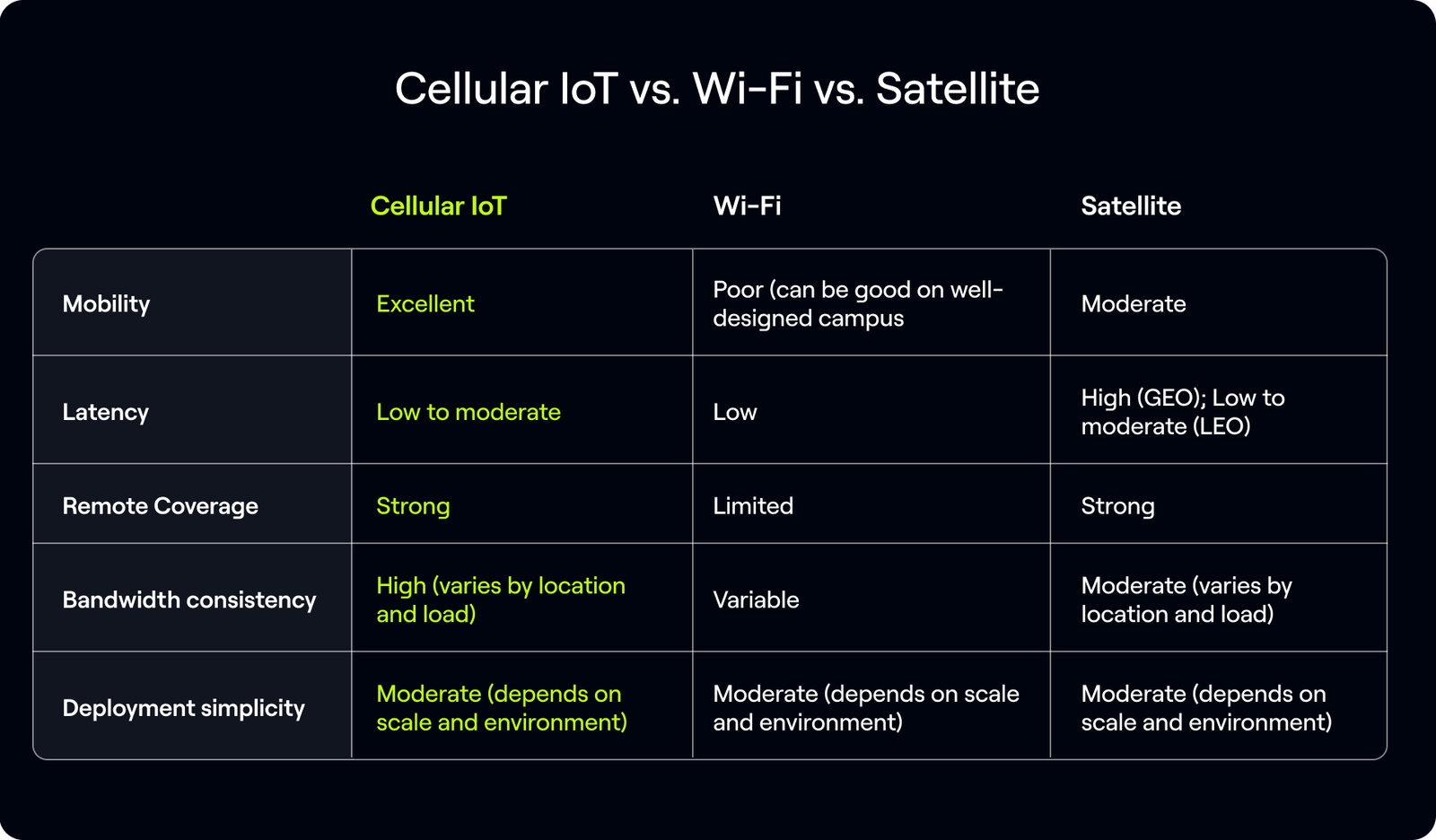
Traditional geostationary satellite links often have ~600+ ms latency, which can be problematic for highly interactive real-time monitoring. Newer low-Earth-orbit systems reduce latency but may involve different cost and coverage tradeoffs.
Wi-Fi offers low latency, but it requires infrastructure. Someone has to install access points, run cables, and maintain the network. For temporary deployments or remote locations, that infrastructure either doesn't exist or costs too much to justify.
When to use a cellular gateway
A cellular IoT gateway acts as a bridge between video devices and cellular networks. It aggregates connections from multiple devices and routes their data through a single cellular uplink.
Gateways prove useful in two scenarios. First, when video devices lack built-in cellular modems, a gateway adds cellular connectivity without replacing the cameras themselves. Second, when you have multiple cameras at a single location, a gateway can consolidate their connections and reduce per-device costs.
Some deployments embed cellular connectivity directly in each device, while others use gateways. The right choice depends on your specific deployment, device capabilities, and cost considerations.
How to manage video IoT devices at scale
When you're managing a handful of video devices, you can handle connectivity issues manually. When you're managing hundreds or thousands, the management tools become just as important as the connectivity itself.
Centralized fleet dashboard
A single interface lets teams monitor all connected video devices, check connectivity status, and troubleshoot issues without logging into multiple systems. Hologram provides real-time visibility across your entire deployment, regardless of where devices are located geographically.
Dashboards enable you to see at a glance which devices are online, which are experiencing connectivity issues, and which might need attention. This visibility prevents small problems from becoming big ones.
Real-time SIM management
Activating, pausing, and configuring SIMs remotely through a dashboard or API eliminates the need for physical access to devices. When a camera at a remote site goes offline, you can troubleshoot the connectivity without sending someone to check on it. When a new device ships to a customer, you handle the activation from your desk.
Usage monitoring and alerts
Tracking data consumption helps prevent overages and identify problems early. Unusual usage patterns often indicate device issues before they cause complete failures. A camera suddenly using twice its normal data might have a configuration problem or a firmware issue worth investigating.
Configurable alerts notify your team when usage approaches thresholds, giving time to investigate before service interruptions occur or bills spike unexpectedly.
Get started with Hologram for video IoT
Video IoT applications demand connectivity that matches their unique requirements: high bandwidth, low latency, global reach, and reliable uptime. Hologram's platform delivers through multi-carrier redundancy, automatic failover, and management tools built for deployments at scale.
Whether you're deploying security cameras, fleet dash cams, or agricultural monitoring systems, the connectivity foundation determines how smoothly everything else runs. Contactour team to discuss your video IoT requirements and explore how Hologram can support your deployment.
FAQs about cellular connectivity for video IoT
Why should I pick Hologram over an alternative?
Hologram differentiates through multi-carrier redundancy and global coverage with a single SIM, along with a 99.95% platform uptime SLA.
How much data does a typical video IoT device use monthly?
Data usage depends on both resolution and how often the camera is sending video. A continuously streaming SD camera can use more data than a 4K camera that only uploads short motion-triggered clips. Higher resolutions increase the bitrate, but motion-triggered or scheduled recording can dramatically reduce total monthly usage. Hologram offers flexible plans that scale with actual consumption.
Can cellular IoT networks support high-definition video streaming?
Yes. LTE and 5G cellular networks provide sufficient bandwidth for HD and even 4K video streaming when coverage is strong. The key is ensuring your deployment location has adequate signal strength from at least one carrier.
What happens to video IoT devices during a carrier outage?
Platforms with multi-carrier support like Hologram can automatically switch to an available backup carrier, minimizing downtime and helping maintain video transmission when another compatible network is available and the device supports it. Single-carrier solutions lack this failover capability, leaving devices offline until the carrier resolves the issue.