What is NB-IoT and WRX? How cellular IoT enables large scale IoT deployments

NB-IoT and WRX enable massive, low-power cellular IoT deployments. Learn about NB-IoT that provides deep coverage for sensors and WRX that extends battery life.
The number of connected devices worldwide is growing rapidly as industries adopt Internet of Things (IoT) technologies to monitor infrastructure, optimize operations, and collect real-time data.
However, connecting millions of small devices presents unique challenges. Many IoT devices operate in remote locations, transmit only small amounts of data, and must run for years on battery power.
Traditional wireless technologies like Wi-Fi or Bluetooth are not well suited for these requirements. They typically consume more power and require local network infrastructure.
This is where cellular IoT becomes essential.
Cellular IoT technologies allow devices to communicate through existing cellular networks while using minimal energy. Technologies such as NB-IoT are specifically designed for low-power devices that transmit small amounts of data over long distances. Power-saving mechanisms like WRX (Wake-Up Receiver) further extend device battery life by minimizing how often a device’s radio is active.
In this article, we’ll explore:
- What cellular IoT is and how it works
- The role of NB-IoT in IoT connectivity
- How WRX improves IoT battery life
- Real-world applications of cellular IoT technologies
What cellular technologies are used for IoT?
Over the past few decades, multiple generations of cellular technology have been used to connect IoT devices. Each generation introduced improvements in speed, coverage, and power efficiency.
Legacy cellular networks
Early IoT deployments often relied on legacy cellular technologies such as 2G GSM and 3G UMTS. These technologies enabled early machine-to-machine communication systems, such as remote payment terminals and vehicle tracking devices.
However, they were originally designed for mobile phones rather than battery-powered sensors. As a result, they were not optimized for devices that transmit small amounts of data infrequently. As telecom providers gradually shut down older networks, industries have shifted toward newer cellular IoT technologies.
LP-WAN networks
Fourth-generation cellular networks introduced more efficient options for IoT connectivity. These technologies are designed for low-power wide-area networking (LPWAN). Instead of transmitting large data streams, they enable devices to send small messages such as sensor readings, status updates, or location information.
- LTE: LTE stands for Long-Term Evolution. It is a fourth-generation (4G) wireless technology standard that provides significantly increased network capacity and speed compared to previous 2G and 3G standards.
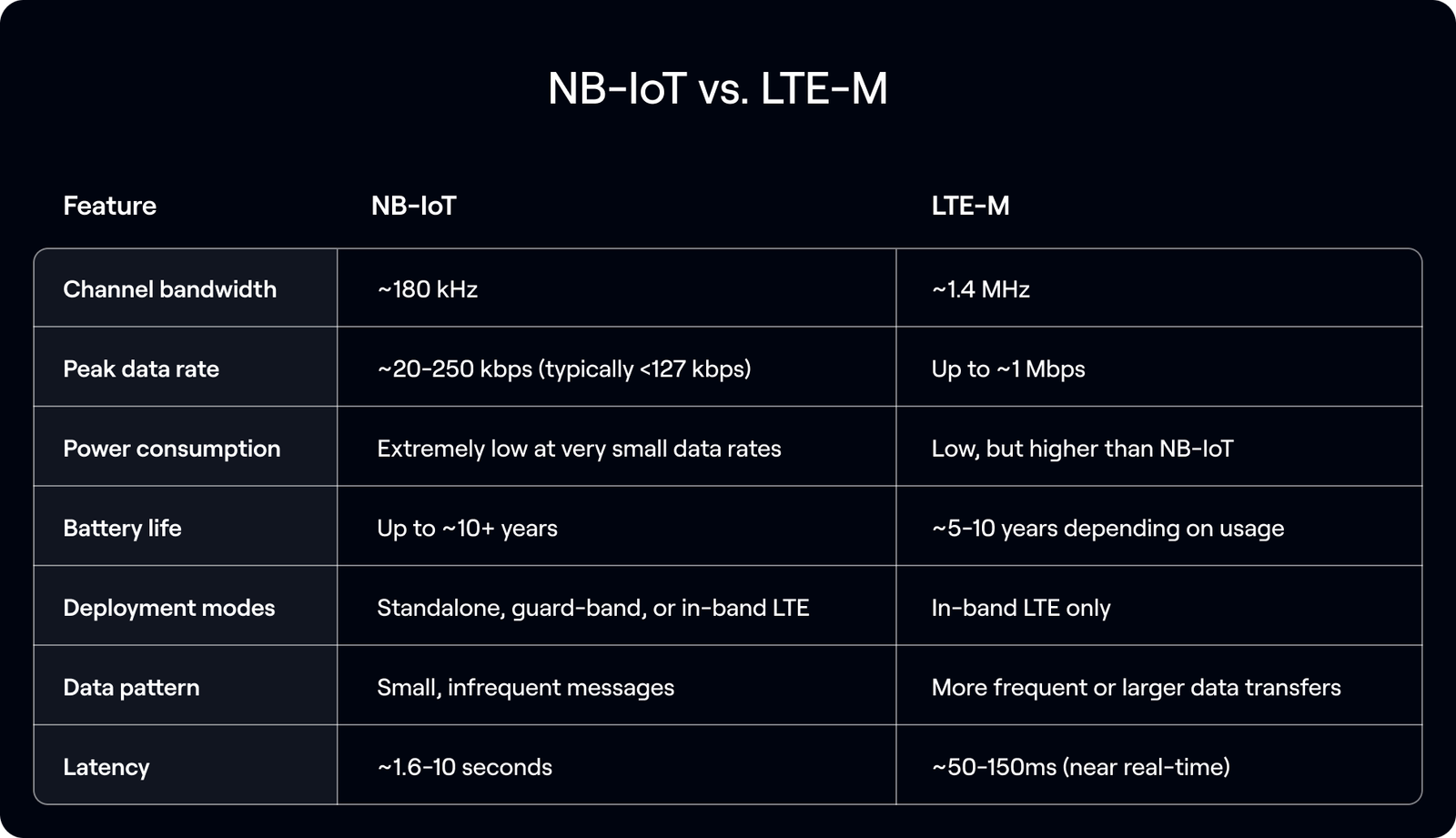
- LTE-M: LTE was primarily designed for high-speed mobile internet access (smartphones, tablets). Variants of it, such as LTE-M, are specifically optimized for IoT applications, offering a balance of bandwidth, mobility, and power efficiency. LTE-M supports moderate bandwidth and mobility, making it suitable for applications like asset tracking or wearable devices.
- NB-IoT: NB-IoT focuses on maximum energy efficiency and device density, making it ideal for large sensor deployments.
What are the benefits of NB-IoT?
NB-IoT is a specialized cellular communication technology designed specifically for low-power IoT devices. Unlike traditional cellular technologies that prioritize high data speeds, NB-IoT focuses on efficiency, reliability, and long battery life.
NB-IoT devices typically transmit small packets of data—such as meter readings or sensor measurements—at scheduled intervals. Because these transmissions are infrequent and low bandwidth, devices can remain in sleep mode most of the time.
Low power consumption
Energy efficiency is one of the primary design goals of NB-IoT.
Many IoT devices are deployed in locations where replacing batteries frequently would be expensive or impractical. Examples include underground utility meters, remote environmental sensors, and industrial monitoring systems.
NB-IoT minimizes power consumption by allowing devices to remain inactive for long periods and wake only when necessary. With proper configuration, many NB-IoT devices can operate for 10 years or longer on a single battery.
Deep indoor and underground coverage
Another major advantage of NB-IoT is its ability to provide strong connectivity in challenging environments.
NB-IoT signals can penetrate walls, buildings, and underground spaces more effectively than many other wireless technologies. This makes the technology particularly valuable for devices located in:
- Basements or utility rooms
- Underground meter vaults
- Industrial facilities
- Parking garages
- Dense urban environments
Improved coverage ensures that sensors and meters can transmit data reliably even when installed in difficult locations.
Low data rates optimized for sensors
NB-IoT prioritizes efficiency over speed. It is designed for applications that transmit small amounts of data rather than continuous streams.
Typical NB-IoT data transmissions include:
- Temperature or environmental sensor readings
- Energy consumption data from smart meters
- Equipment status updates
- Location information from tracking devices
Because the data payloads are small, networks can support extremely large numbers of devices simultaneously.
Massive device scalability
NB-IoT networks can support millions of devices per square kilometer, enabling massive IoT deployments.
This scalability is essential for applications such as smart city infrastructure, where thousands of sensors may be deployed throughout an urban environment.
What is WRX in NB-IoT?
Battery life is one of the most critical factors in IoT device design. To extend device lifetimes, cellular IoT technologies include several mechanisms that reduce energy consumption. One of these mechanisms is WRX (Wake-Up Receiver or Windowed Reception).
How WRX works
WRX allows an IoT device to remain in a low-power sleep state most of the time. Keeping the radio active continuously drains the battery quickly. With WRX, the device wakes up at scheduled intervals to check whether the network has any pending messages.
Here’s how a typical WRX cycle works:
- The device enters a deep sleep mode where most components are powered down.
- At predefined intervals, the receiver briefly activates.
- The device listens for paging signals from the network.
- If the network has data to deliver, the device establishes communication.
- If no message is detected, the device returns to sleep.
Because the receiver is active only for short periods, the device consumes significantly less energy.
Why WRX matters for IoT battery life
WRX is critical for enabling long-term IoT deployments. Without power-saving mechanisms like WRX, many IoT devices would require frequent battery replacement. This would increase maintenance costs and make large-scale deployments impractical.
By reducing the amount of time the radio is active, WRX enables devices to achieve:
- Multi-year battery life
- Lower operational costs
- Minimal maintenance requirements
- Reliable long-term deployments
WRX is often used alongside other cellular IoT power-saving technologies such as:
- Power Saving Mode (PSM) – allows devices to remain unreachable for extended periods while conserving power
- Extended Discontinuous Reception (eDRX) – increases the interval between paging cycles to reduce energy usage
Together, these mechanisms help ensure that IoT devices can operate efficiently for many years.
Real-world applications of NB-IoT
NB-IoT is already being used across many industries to support large-scale IoT deployments. Because the technology combines wide-area connectivity with low power consumption, it is particularly well suited for sensors and monitoring systems.
Smart utility metering
One of the most widely adopted NB-IoT applications is smart utility metering.
Electricity, gas, and water providers use NB-IoT meters to automatically transmit consumption data to central systems. This eliminates the need for manual meter readings and allows utilities to monitor usage in real time.
For example, smart meter deployments allow utilities to detect problems such as water leaks or electricity outages more quickly. Automated reporting also improves billing accuracy and provides customers with more detailed information about their energy consumption.
In many countries, utilities are deploying millions of connected meters as part of national smart grid initiatives.
Smart cities and infrastructure monitoring
Cities around the world are deploying IoT sensors to improve urban infrastructure and services.
NB-IoT enables large networks of connected sensors that monitor conditions across an entire city. These sensors collect data that helps city planners optimize transportation, improve public services, and reduce environmental impact.
For example, a deployment in Hamburg installed NB-IoT parking sensors across approximately 11,000 parking spaces, providing drivers with real-time information about parking availability.
Other smart city applications include:
- Air quality monitoring sensors that track pollution levels
- Waste management sensors that detect when bins need to be emptied
- Structural sensors that monitor bridges and infrastructure for damage
- Traffic monitoring systems that analyze vehicle flow
These systems allow cities to operate more efficiently while improving quality of life for residents.
Smart agriculture and environmental monitoring
Agriculture is another industry benefiting significantly from cellular IoT technologies. Farmers increasingly rely on sensor networks to monitor soil conditions, weather patterns, and crop health. NB-IoT sensors can collect environmental data across large agricultural areas without requiring extensive network infrastructure.
For example, soil moisture sensors connected through NB-IoT can automatically trigger irrigation systems when crops need water. This helps farmers conserve water while maintaining optimal growing conditions.
Other agricultural applications include:
- Livestock tracking using connected tags or collars
- Climate monitoring sensors for greenhouses
- Remote monitoring of irrigation systems
- Crop health monitoring across large fields
In Norway, researchers have even deployed NB-IoT trackers on sheep to monitor livestock movement.
The future of cellular IoT
Although NB-IoT provides many advantages, there are still some limitations to consider. NB-IoT supports relatively low data throughput compared with traditional cellular networks. This makes it unsuitable for applications requiring high bandwidth, such as video streaming.
Latency can also vary depending on power-saving configurations. Devices that remain in sleep mode for long periods may take longer to respond to incoming messages.
As cellular networks evolve, IoT connectivity will continue to improve. Next-generation technologies such as 5G will enable even larger device deployments while supporting new capabilities like ultra-low latency and edge computing. These advancements will unlock new possibilities for connected infrastructure, autonomous transportation, and industrial automation.
FAQs
What is NB-IoT?
NB-IoT (Narrowband Internet of Things) is a low-power cellular technology designed for IoT devices that transmit small amounts of data over long distances.
It operates on licensed cellular spectrum and is optimized for devices that need long battery life, reliable coverage, and low bandwidth communication.
NB-IoT is commonly used for:
- Smart utility meters
- Environmental sensors
- Smart city infrastructure
- Asset tracking devices
- Agricultural monitoring systems
Because devices transmit small packets of data only occasionally, NB-IoT devices can often run for 10 years or more on a single battery.
How does NB-IoT work?
NB-IoT devices communicate with cellular base stations using a narrow radio bandwidth, which reduces power consumption and improves signal penetration.
The communication process typically works like this:
- An IoT sensor collects data (such as temperature or energy usage).
- The device wakes from sleep mode.
- It transmits a small data packet through the cellular network.
- The data is sent to a cloud platform or application server.
- The device returns to sleep mode to conserve power.
This architecture allows networks to support millions of devices simultaneously.
What is WRX in NB-IoT?
WRX (Wake-Up Receiver or Windowed Reception) is a power-saving mechanism used in cellular IoT devices.
WRX allows a device to remain in low-power sleep mode most of the time and wake up periodically to check if the network has any incoming messages.
If no message is detected, the device returns to sleep immediately.
This mechanism helps extend IoT device battery life significantly, enabling deployments that last many years without maintenance.
What is the difference between NB-IoT and LTE-M?
LTE-M and NB-IoT are both cellular IoT technologies, but they are optimized for different use cases.
NB-IoT
- Lower power consumption
- Lower data rates
- Better indoor coverage
- Ideal for stationary sensors and meters
LTE-M
- Higher data speeds
- Lower latency
- Supports device mobility
- Suitable for asset tracking and wearable devices
In general, NB-IoT is best for massive sensor deployments, while LTE-M is better for devices that require more frequent communication or mobility.
What are the benefits of cellular IoT?
Cellular IoT provides several advantages compared with other IoT connectivity technologies. Key benefits include:
- Wide-area connectivity: Devices can connect across cities, highways, and rural environments using existing cellular infrastructure.
- Strong security: Cellular networks use SIM-based authentication and encrypted communication.
- Scalability: Modern cellular networks can support millions of connected devices simultaneously.
- Long device lifespan: Power-saving technologies allow devices to operate for many years on a single battery.
These advantages make cellular IoT ideal for large-scale infrastructure monitoring and sensor networks.