Fixed Wireless Access (FWA) in action: Keeping retail connected

In today's omnichannel retail environment, reliable and high-speed internet connectivity is crucial for maximizing operations, delivering exceptional customer service, and increasing competitiveness. Fixed Wireless Access (FWA) is a game-changing solution for retail connectivity, offering rapid deployment, cost-effectiveness, and flexibility. This ebook explores how FWA can transform connectivity for retail businesses, enabling them to stay ahead in an increasingly digital marketplace.

The retail resurgence
Brick and mortar shopping is alive and critical for brands in the competitive retail space. In the U.S., brick-and-mortar stores account for 85% of total retail sales, totaling $7.05 billion in 2023. Projections indicate U.S. retail sales will increase dramatically, hitting $8.05 trillion in 2028. Similarly, global in-store retail sales are strong and expected to total $21.8 trillion in 2024, up 4.81%. Even with the continued rise of online shopping, the in-store experience remains a crucial part of the retail ecosystem.
Consumers expect excellence
Despite the convenience of online shopping, 75% of consumers say excellent in-store service makes them more likely to buy. Customers value human interaction like expert advice, customized recommendations, or simply asking a live person for help, all of which improves their overall shopping experience. To deliver that excellence and set the in-store experience apart, brands like Apple, Nike, and Lush are using interactive showcases to engage customers and build long-term loyalty. Emerging brands like eyewear innovator Gentle Monster are completely reimagining the in-store experience, with Art-Driven Retail and Immersive Store Design.
In-store pick up generates additional revenue
Buy Online, Pick Up In-Store (BOPIS) and curbside pickup lead to additional sales. More than 37% of shoppers make an additional purchase when picking up an order in-store. During seasonal peak shopping times, that number increases to 86%. When customers step inside the store, retailers can serve up digital promotions and personalized product information to drive additional spending.
Physical stores enable omnichannel logistics and delivery
Technology is also enabling retailers to turn their stores into fulfillment centers to optimize inventory and speed up delivery. Target, Walmart, Best Buy, and more have all adopted a ship-from-store strategy, using the physical store as mini-distribution hubs to reduce costs and get products to customers faster. Even small and mid-sized businesses can use store locations to fulfill local orders, offer same-day pickup, cut costs, and improve customer experience. A recent study revealed that 73% of Gen Z and 75% of millennials say they would shop more at small businesses if they offered the same convenience as larger chain stores.
The common denominator? Connectivity
Clearly retail is alive and thriving as a key part of consumer experience and brand engagement. Internet connectivity is key to deliver what we’ve describe above. However, retail businesses face multiple connectivity challenges:
- Need for reliable, high-speed internet for POS systems, inventory management, customer Wi-Fi, and new customer experiences
- Difficulty in obtaining fast internet in some locations, especially in rural or developing areas
- High costs and long wait times for installing traditional wired solutions
- Requirement for flexible and scalable solutions to adapt to changing business needs
That’s exactly where Fixed Wireless Access (FWA) delivers.
Introduction to Fixed Wireless Access (FWA)
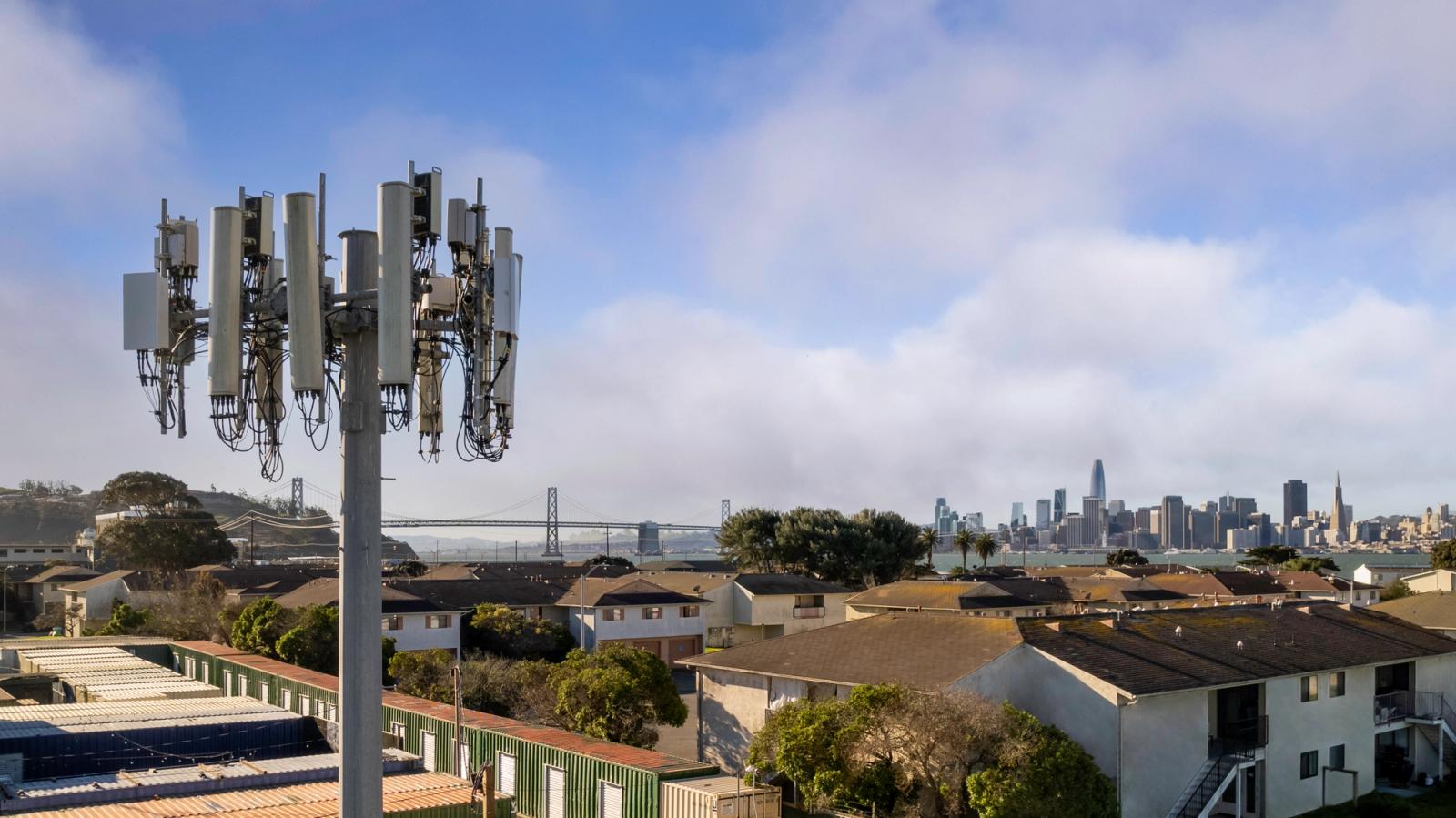
Fixed Wireless Access (FWA) is an innovative method of delivering high-speed internet to fixed locations using wireless cellular network technology. Instead of relying on traditional wired infrastructure like fiber or cable, FWA leverages wireless cellular networks to provide fast broadband connectivity.
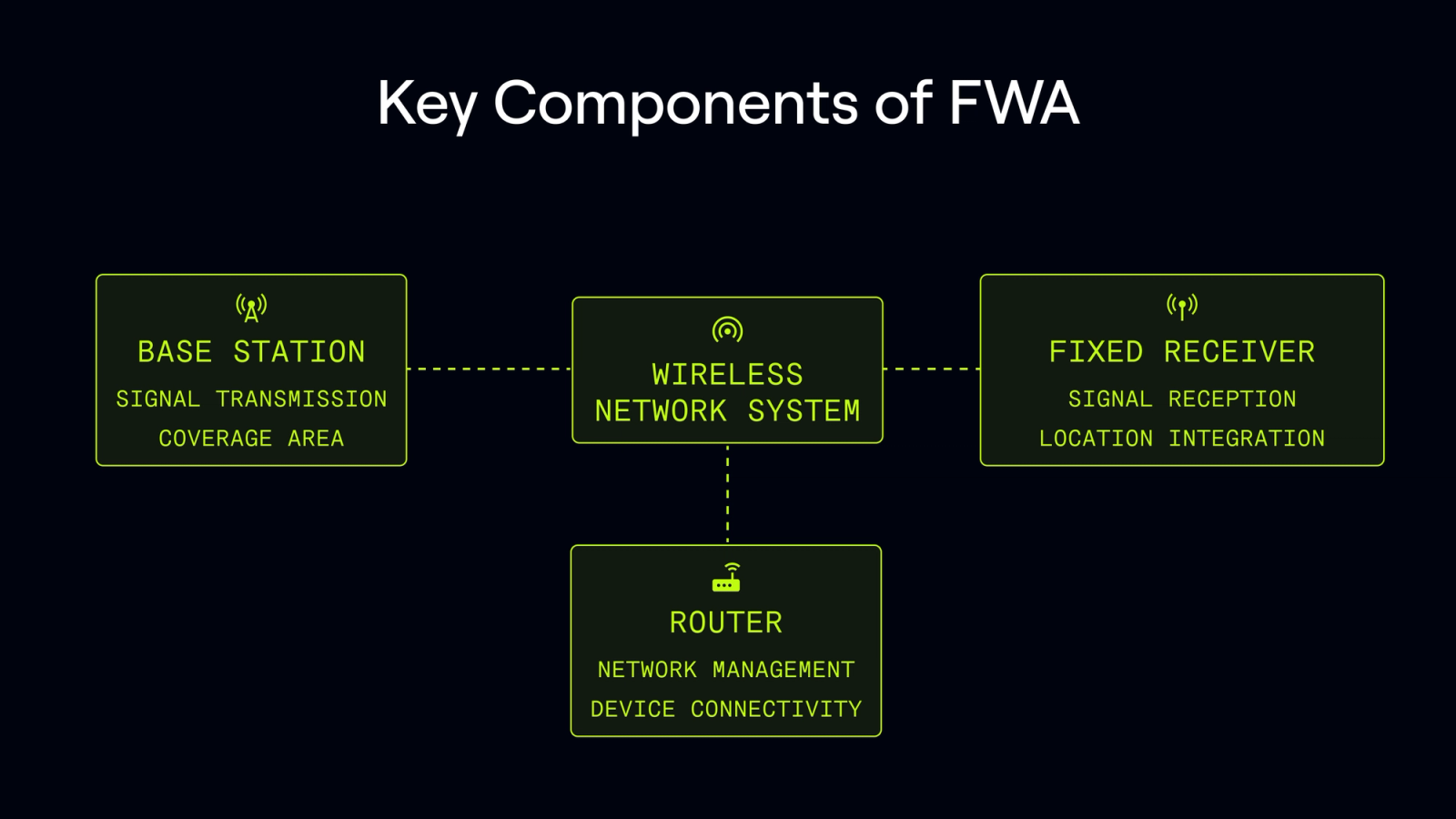
Let’s take a deeper look at FWA. FWA uses the same network as your mobile phone and your cellular IoT devices — 3G, 4G LTE, or even the latest 5G network. Here’s how it works:
- Base station: A local base station (usually a cell tower) sends a wireless signal to a specific area. This station acts as the hub for the internet connection.
- Fixed receiver: The retails location is equipped with a fixed receiver that catches the signal from the base station.
- Internet router: The signal is then transferred to a router inside the retail space, which broadcasts the internet within the store.
Benefits of FWA for Retail
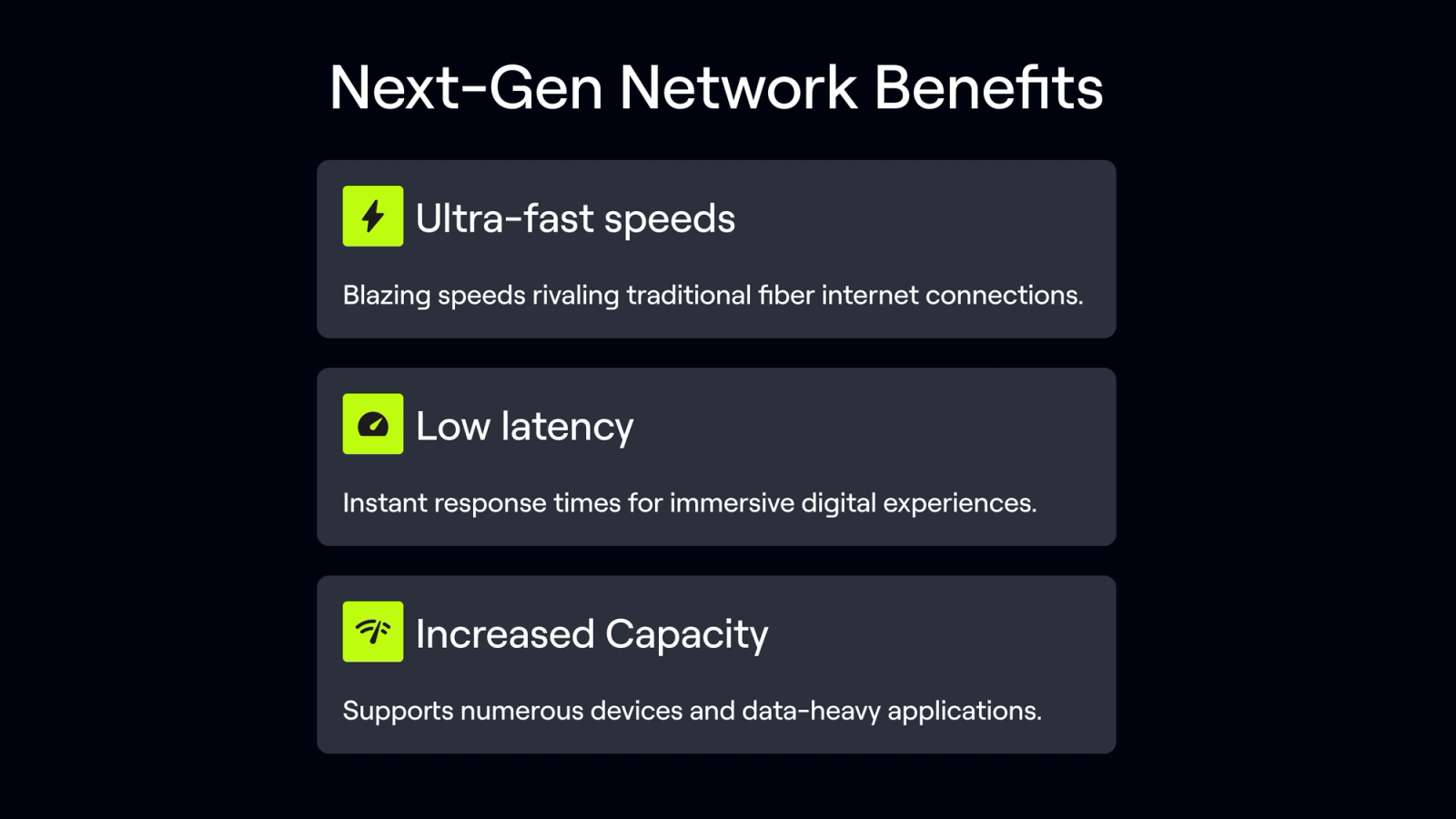
With ultra-fast speeds, low latency, and increased capacity, FWA offers multiple benefits over traditional wired solutions.
- Rapid deployment. Unlike traditional wired solutions that can take months to install, FWA can be set up within days. This allows retailers to quickly open new locations or pop-up stores, rapidly respond to connectivity issues or outages, and implement new technologies and services without delay.
- Cost-effectiveness. FWA often provides a more affordable option for both providers and retailers by eliminating the need for expensive cable installations, reducing ongoing maintenance costs associated with physical infrastructure, and offering flexible pricing models aligned with business needs.
- Scalability and flexibility. As retail businesses grow or need increased bandwidth, FWA can adapt and enable retailers to easily upgrade bandwidth as needs increase, quickly add new connected devices or services, and seamlessly integrate with existing systems and IoT devices.
- Wide coverage. FWA can provide high-speed internet to areas where traditional wired options are limited. It enables consistent connectivity across multiple store location, supports retail expansion into underserved or rural areas, and ensures backup connectivity for mission-critical operations.
- 5G performance. With the rollout of 5G networks, FWA offers even greater benefits including ultra-fast speeds comparable to fiber connections, low latency for real-time applications like augmented reality shopping experiences, and increased capacity to support more connected devices and data-intensive applications.
FWA in action for retailers
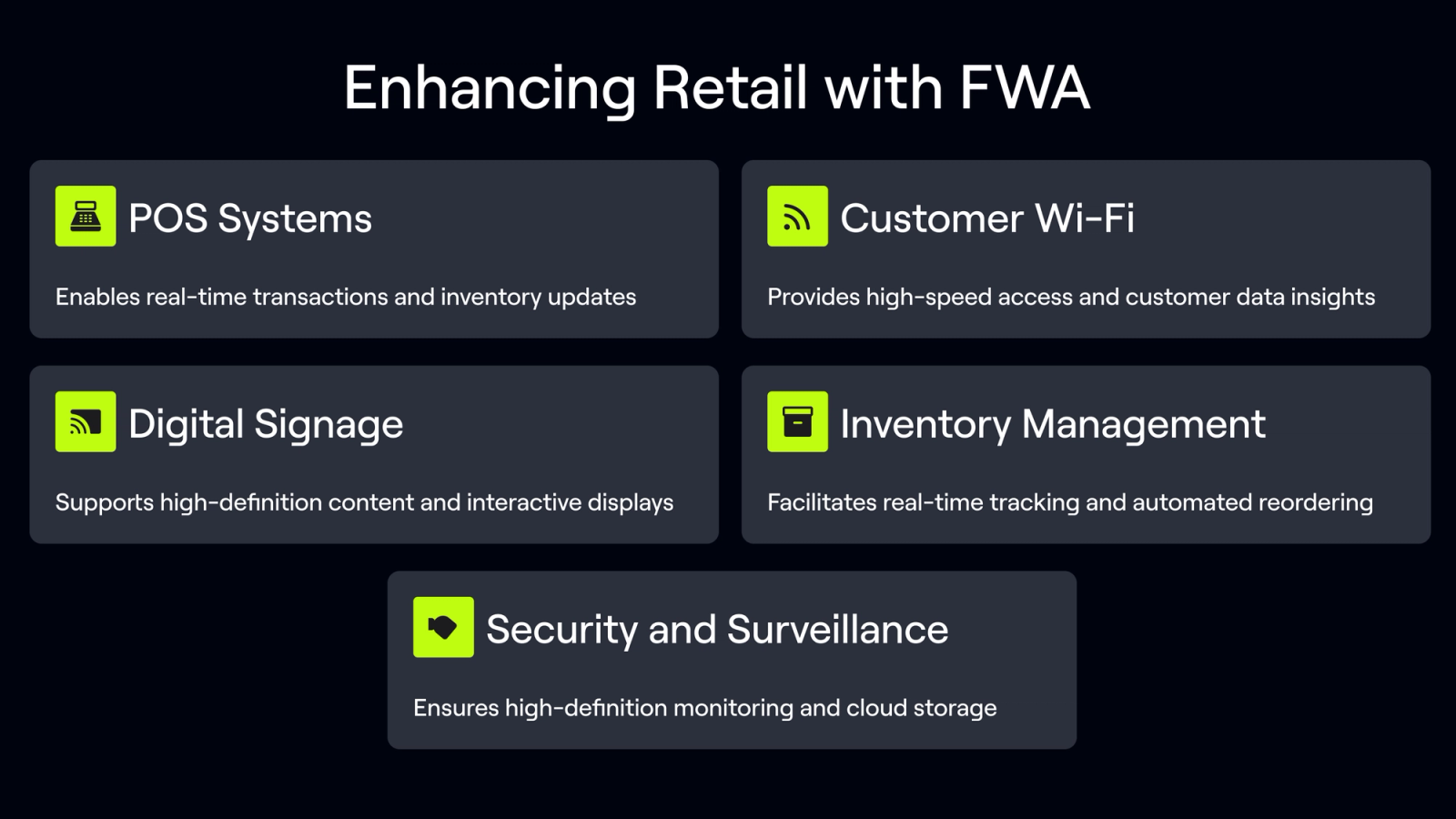
As retailers look to leverage the in-store experience to build their brands, engage with customers, and improve the shopping experience, FWA powers multiple use cases for retailers.
Point-of-Sale (POS) systems
Mobile POS devices enable retailers to offer customers more choices and shorten wait times. These devices are rapidly becoming an essential part of retail operations with an estimated USD $113.49 Billion by 2030, rising at a CAGR of 20.87%. FWA provides reliable connectivity for cloud-based POS systems, enabling real-time transaction processing, inventory updates across multiple locations, and seamless integration with online sales channels.
High speed customer Wi-Fi
Offering fast, free Wi-Fi is now a standard expectation for many shoppers. It improves the customer experience, enabling them to research products and share on social media. FWA allows retailers to provide high-speed internet access to customers to help them gather valuable data on customer behavior and preferences and implement location-based marketing and personalized offers.
FWA is a great way for retailers to quickly take advantage of benefits of cellular without the long cycles in installations needed for wired networks. We're seeing first-hand how it's helping retailers rapidly roll out new services and innovations.
– Pat Wilbur, CTO, Hologram
Digital signage and interactive displays
Interactive video displays and connectivity are transforming the retail landscape, deliver a more engaging and personalized shopping experience. Customers can interact with products, receive real-time information, and even virtually try on items, ultimately boosting engagement and sales. FWA supports bandwidth-intensive applications like high-definition digital signage with real-time content updates, interactive product displays and virtual try-on experiences, and in-store video streaming for product demonstrations.
Inventory management
Smart shelves powered with IoT sensors can indicate when products need to be restocked for more effective inventory management. Retailers can also use digital signage to make real-time pricing adjustments thanks to enhanced inventory management with the use of Cellular IoT. Connected inventory systems powered by FWA enables real-time stock tracking across multiple locations, automated reordering based on sales data, and efficient omnichannel fulfillment.
Security and surveillance
To protect the health of employees and customers, retailers can leverage IoT-powered devices to monitor air quality, flow, and humidity. With Cellular IoT connected video cameras, retailers learn trends and identify behaviors outside the norm to help with loss prevention. IoT sensors can also be used for geofencing that can identify when products leave certain areas of the store. FWA provides the necessary bandwidth for advanced security measures high-definition security camera feeds, real-time monitoring and alerts, and cloud-based video storage and analysis.
It’s easy to get started with FWA
Clearly FWA offers a wide range of benefits for retailer - from delivered an elevated customer experience for increased revenue to streamlining logistics and returns for cost savings.
If you’re ready to see how FWA might help solve the connectivity challenges that may be holding you back, here are seven steps to consider.
- Assess current and future connectivity needs
- Evaluate FWA coverage in target locations
- Compare costs and performance with traditional options
- Choose a reliable FWA provider with experience in retail solutions
- Plan for seamless integration with existing systems
- Implement robust security measures to protect sensitive data
- Train staff on new systems and capabilities
Get a competitive advantage with FWA
Fixed Wireless Access represents a powerful solution for retail businesses seeking fast, reliable, and flexible internet connectivity. By leveraging FWA, retailers can enhance operations, improve customer experiences, and stay competitive in an increasingly digital marketplace. As 5G networks continue to expand, the potential of FWA in retail will only grow, offering even greater opportunities for innovation and growth.