Connectivity
Mobile cores, roaming, steering, and eUICC explained
Connectivity can sound complicated. Here is what mobile cores, roaming, eUICC, and multi-core architecture each actually do.

May 21, 2026

Fleets of cellular IoT connected devices can show full signal bars across every device, yet traffic stops flowing, sessions fail, and entire regions go dark. The problem is not the radio network. It is the mobile core, the backend infrastructure that authenticates your SIM cards, routes your data, manages sessions, and keeps everything alive. When it goes down, roaming across 500 carriers means nothing.
This is the gap most IoT teams miss. They focus on carrier count and coverage maps and ignore the infrastructure layer that actually controls connectivity. Understanding mobile cores, roaming, carrier steering, and eUICC gives you the blueprint to build deployments that survive real-world failures, not just theoretical ones.
A mobile core is the backend carrier infrastructure that authenticates SIM cards, routes data traffic, manages connectivity sessions, and handles billing. eUICC is the software layer on a SIM that lets you download, switch, manage, and migrate carrier profiles over the air without physically replacing the card. Together with multi-core architecture and smart orchestration, they form the foundation of enterprise-grade IoT reliability.
TL;DR
- A mobile core handles SIM authentication, packet routing, session management, and data breakout. If it fails, your devices lose connectivity even with full signal bars.
- Roaming gives you access to more radio networks. Multi-core architecture gives you infrastructure redundancy. They solve different problems.
- eUICC lets you update, swap, manage, and migrate carrier profiles remotely via over-the-air (OTA) updates across your entire fleet without truck rolls.
- Carrier steering matters less than you think once you have dual-core failover and OTA profile management.
- Hologram's Outage Protection SIMs run on two independent mobile cores with automatic failover, backed by eUICC and Conductor for fleet-wide orchestration across 190+ countries and 550+ carriers.
What is a mobile core and why does it break your deployment?
What is a mobile core in cellular IoT? A mobile core is the carrier backend that handles SIM authentication, packet routing, APN (Access Point Name) services, policy control, roaming agreements, data breakout, and billing. Think of it as the control center between the radio network and the internet. Your device talks to a tower, but the core decides whether that conversation goes anywhere.
This distinction matters because the radio network and the mobile core are separate systems. Your device can show full signal, stay attached to a nearby tower, hold an active registration, and still be completely offline if the core fails. Authentication breaks, sessions drop, roaming collapses, and traffic stops flowing. No amount of carrier diversity fixes a dead core.
Single-core risk is the hidden vulnerability
Most cellular IoT providers tie radio access and core infrastructure together. Your SIM can roam across dozens of carriers globally, but all traffic still tunnels back through one backend core. That single dependency creates a failure point that only becomes obvious during an actual outage.
Multi-IMSI (International Mobile Subscriber Identity) approaches hit the same wall. IMSI changes happen inside the same mobile core, so switching identities does not switch infrastructure.
How dual-core architecture changes the equation
Hologram built multi-core SIMs to separate two failure domains that most providers still bundle together:
- Radio and network availability: which tower and carrier your device attaches to
- Core availability: the backend infrastructure authenticating and routing your traffic
Hologram's Outage Protection SIMs carry two independent mobile cores. If Core A fails, the SIM automatically switches to Core B. The device reattaches through a completely separate infrastructure stack. The entire failover happens automatically, without manual intervention or extended downtime.
That gives you redundancy at the carrier level, the roaming level, the authentication level, and the packet core level. That means more infrastructure, not just more towers.
How roaming and multi-core solve different problems
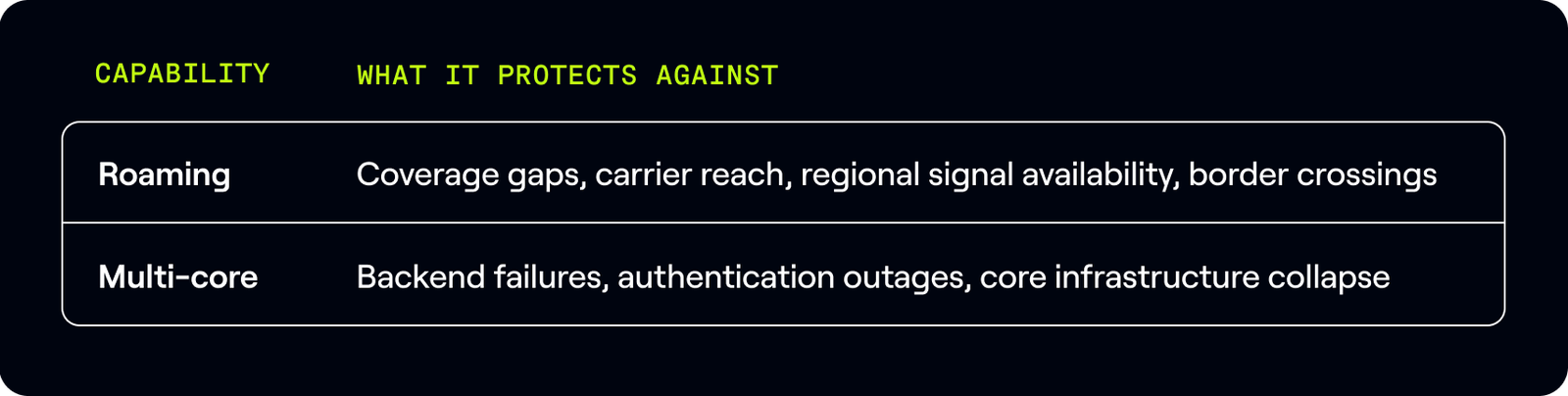
What is the difference between roaming and multi-core redundancy? Roaming expands your radio access across carrier networks and geographies. Multi-core adds infrastructure redundancy at the backend. Roaming keeps you connected when you cross borders. Multi-core keeps you connected when backend systems fail.
What roaming actually does
Roaming lets your SIM attach to a foreign carrier's radio network. A Hologram SIM in Germany attaches to Deutsche Telekom towers even though Hologram is not Deutsche Telekom. The local carrier gives you tower access and radio connectivity, including LTE (Long-Term Evolution) and 5G attachment.
But the session still routes back to the SIM provider's home infrastructure:
Device > Local radio network (visited carrier) > Roaming exchange > Home mobile core > Internet/cloud
Roaming solves coverage gaps, carrier reach, international deployment, and local signal availability. It does not eliminate dependency on the home core.
Where roaming fails
A standard roaming SIM, even one that roams across 500 networks, still funnels all traffic through a single home core. If that core's provider goes down:
Authentication fails, PDP (Packet Data Protocol) contexts drop, sessions terminate, and roaming collapses with them.
A device can attach to a local tower and still fail to authenticate or route traffic. A device can show perfect signal and still sit completely offline if the core has failed. That is the failure mode most teams never plan for.
Multi-core fills the gap roaming cannot
Both matter, but conflating them leads teams to overestimate their resiliency. Broad roaming plus a single core still has a single point of failure.
eUICC and OTA: manage your fleet without touching hardware
What is eUICC and why does it matter for IoT? eUICC transforms the SIM from a static hardware credential into a remotely manageable connectivity platform. It lets you download, switch, manage, and migrate carrier profiles over the air. You can update your entire fleet remotely without physical SIM swaps, field visits, or truck rolls.
The cost of not having eUICC
Without eUICC, any change to your carrier relationship, pricing, regional coverage, roaming agreements, sunset timelines, or regulatory requirements could mean physically replacing SIM cards. For deployed sensors, vehicles, medical devices, utility infrastructure, and remote industrial assets, that is operationally devastating.
What Hologram Hyper SIMs with eUICC unlock
With OTA eUICC management through Hologram Hyper SIMs, you can:
- Update SIMs to optimize coverage or performance
- Push new carrier profiles remotely
- Recover from geopolitical or carrier disruptions
- Migrate fleet connectivity without touching hardware
- Switch points of presence as business needs shift
That dramatically extends deployment lifespan. With over 18 billion connected IoT devices worldwide and growing, remote management is no longer optional. You no longer lock your hardware to one connectivity provider. For devices that stay in the field for years or decades, this flexibility is a foundational need.
Carrier steering matters less than you think
What does carrier steering mean? Steering happens when a SIM provider uses wholesale costs, preferred roaming agreements, traffic optimization, or contractual obligations to bias your device toward specific carrier partners. The telecom industry markets "non-steered roaming" and "steering-free" access as major differentiators. In practice, steering matters far less than backend resiliency.
Why steering drops in importance
Once you have dual mobile cores, broad roaming, OTA profile management, and automatic failover, the initial carrier selection policy becomes a secondary concern. A perfectly non-steered SIM on a single core still fails badly if that core's infrastructure goes down, its authentication layer breaks, or its roaming hub collapses.
A multi-core SIM survives those events. That is a much larger operational win.
Hologram offers non-steered access regardless of which core your SIM connects to. But the real resiliency comes from having multiple cores, not from the absence of steering. With multiple cores you get access to hundreds of roaming networks on both cores, automatic fallback, second-core failover, and OTA profile replacement.
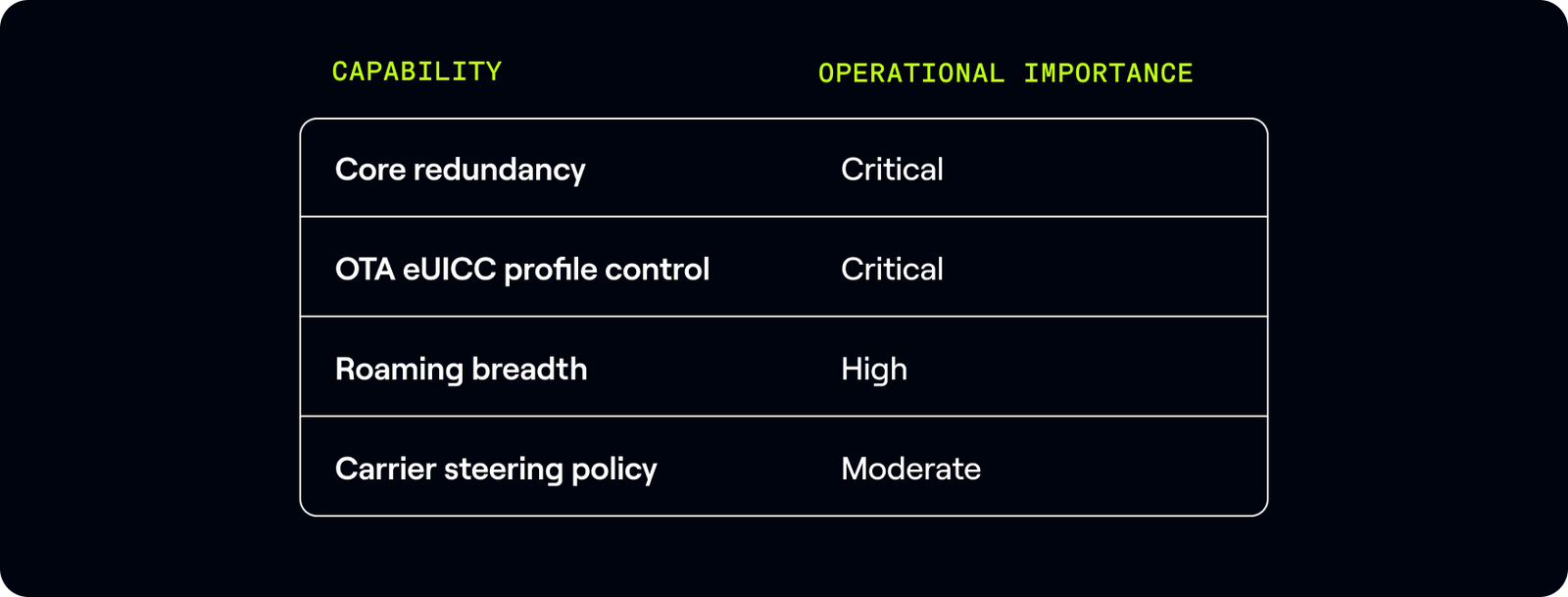
Focus your architecture decisions on the top of this list, not the bottom.
Fleet orchestration ties it together
As fleets grow, connectivity management becomes a software orchestration challenge. You need centralized tools that automate failover, manage profiles, recover connectivity, and push updates across thousands of devices without manual intervention.
Conductor is Hologram's SIM orchestration platform. It works with Hologram Hyper eUICC SIMs to automate profile lifecycle management, define failover rules, recover connectivity, and optimize carrier selection without physical device access across fleets of any size. Hyper SIMs that run on SGP.32 unlock Conductor's full feature set. You can learn more about in our eUICC guide, the GSMA's (GSM Association) latest remote SIM provisioning specification.
Missing towers rarely cause IoT outages. They come from core and carrier failures, internet infrastructure outages, roaming disputes, profile corruption, APN and routing issues, and provisioning failures. Multi-core Outage Protection SIMs with eUICC directly address those challenges. The real strategic advantage is solving for infrastructure continuity, not just radio access.
As your IoT fleet scales globally, resilience depends on backend architecture decisions more than carrier count. Multi-core infrastructure, OTA profile management, flexible orchestration tools, and broad roaming coverage together create a connectivity model built for long-term operational continuity. Hologram's platform serves 5,000+ customers across retail, healthcare, logistics, smart cities, and manufacturing, and brings this architecture to deployments in 190+ countries across 550+ carriers.
Talk with an IoT expert to learn more.
FAQs
What happens to my IoT devices if the mobile core goes down?
Your devices lose the ability to authenticate, establish sessions, route traffic, and reach the internet, even if they still show signal bars and connect to local towers. Without a functioning core, roaming stops working too. Dual-core architecture lets your SIM automatically fail over to a second independent core.
Can roaming across many carriers replace multi-core redundancy?
No. Roaming expands your radio access but all traffic still routes through a single home core. If that core fails, every device on every roamed network loses connectivity. Multi-core adds a separate failure domain that roaming alone cannot address.
Do I need eUICC for my IoT deployment?
For any deployment that will stay in the field longer than a year or scale beyond a pilot, eUICC is essential. It lets you change carrier profiles, push updates, recover from disruptions, and adapt to market changes without physically touching devices. The alternative is truck rolls, and those costs add up fast.
What is the difference between multi-IMSI and multi-core?
Multi-IMSI switches between subscriber identities on the same core infrastructure. If the core goes down, every IMSI on it fails. Multi-core runs on two independent backend infrastructure stacks, so a failure in one does not affect the other.
How does Conductor help manage IoT SIM fleets?
Conductor automates profile lifecycle management, failover rules, connectivity recovery, and fleet-wide orchestration. It works with Hologram Hyper eUICC SIMs to handle at scale what would otherwise need manual intervention on each device.